


Empire of the Hunt: How Hounds Connected the Civilizations of Eurasia
From the earliest times, hunting was more than a means of survival. It was also a symbol of power — a ritual through which rulers demonstrated their command over both nature and people. Nowhere was this more evident than in Eurasia, where hunting traditions linked Egypt, Persia, China and Europe into a vast cultural network. As Thomas T. Allsen shows in his book The Royal Hunt in Eurasian History, the royal hunt became a powerful form of political representation, a stage on which authority, wealth and order were made visible. The exchange of animals, especially dogs, developed into both a diplomatic practice and a shared cultural language connecting courts from the Mediterranean to the Mongolian steppe. Through these encounters between civilizations, hunting ceased to be merely a practical activity and became an expression of a universal idea of kingship
The Origins and Domestication of the Dog
A genetic study by Charles Vilà and his colleagues confirmed that the ancestor of the domestic dog (Canis familiaris) was the wolf (Canis lupus). Dogs may have been domesticated on several separate occasions, while repeated interbreeding with wolves could help explain the remarkable degree of phenotypic diversity seen among dogs. Based on their analysis of genetic material, the researchers suggested that domestication may date back roughly 100,000 years.
Although the wolf ancestry of dogs is widely accepted, paleontologists and archaeologists generally place domestication much later. In Juliet Clutton-Brock’s reconstruction of canine cultural history, the earliest archaeological evidence of domestication dates to around 14,000 years ago and comes from Germany. Some 2,000 years later, evidence of dogs appears at Natufian sites in the Levant. By around 9,000 years ago, domesticated dogs appear to have been common in human communities across both the Old and New Worlds. Clutton-Brock argues that dogs were used for hunting from very early times, particularly alongside long-range projectile weapons. The first clearly distinguishable breeds emerged about 4,000 years ago, and by the Roman period the main types — hunting dogs, guard dogs, sheepdogs and lapdogs — were already well defined.
Dogs and Humans: A Bond Beyond Utility
Whatever one thinks of the cliché that a dog is man’s best friend, there is little doubt that humans and dogs readily form powerful and lasting bonds. The Greeks, like many other peoples, understood that dogs — particularly hunting hounds — could become intensely attached to their owners, displaying extraordinary loyalty and even a willingness to sacrifice themselves. Ancient Chinese accounts likewise described dogs saving their owners’ lives or dying of grief after a master’s death, behaviour interpreted as evidence of righteousness and even a capacity for moral judgement.
People, in turn, often responded to this devotion with deep affection. The Egyptian pharaoh Ramesses IX, who ruled from 1131 to 1112 BCE, was buried with a faithful and beloved dog — an animal that, naturally, had its own name. Giving animals individual names, thereby recognising them as distinct social beings, was common in ancient China, classical Greece, the medieval Islamic world and early modern India. In all these cases, the animals concerned were hunting dogs, evidently regarded as worthy companions in a noble pursuit. Similar attitudes, as we shall see, shaped the relationships between royal hunters and the other trained animals that accompanied them.
Egypt and the Rise of Hunting Breeds
The early development of specialised hunting breeds is particularly well-documented in the case of the Egyptian greyhound. Some researchers have argued that greyhounds were domesticated directly from wolves, but the prevailing view has been that their immediate ancestor was the pariah dog of Africa and West Asia. Whatever their exact origin, greyhound-like dogs appear in rock art from Egypt’s eastern and western deserts during the Predynastic Period. Much clearer depictions of greyhounds and the closely related Saluki occur frequently in later Egyptian art. These images suggest a transformation in the greyhound type between the late Predynastic and Dynastic periods: a heavier ancestral form with upright ears gradually gave way to the more graceful animal associated with the modern breed.
Greyhounds and Salukis are related, but they are distinct breeds. Confusion arises because both are sighthounds — dogs that pursue prey primarily by sight — and share a similar physique, with long legs and deep chests suited to speed and endurance across the open landscapes of the Middle East. There are nevertheless clear differences in their coats and, especially, their ears: Salukis have long, hanging ears, while greyhounds have much shorter ears. Greyhounds and Salukis almost certainly became the basic models from which later sighthound breeds developed, including Afghan hounds and various wolfhounds.
Depictions of greyhounds and Salukis at the hunt become increasingly common from Egypt’s Middle Kingdom, conventionally dated here to 2134–1785 BCE. The dogs are often shown in packs and on leashes, accompanying hunters on foot armed with bows and arrows, or assisting royal hunters pursuing foxes, gazelles, hyenas, onagers and other desert animals from chariots.
Sighthounds may have been the pre-eminent hunting dogs of the central regions of Eurasia, but they were not the only ones. Diodorus Siculus, writing in the first century BCE, recognised greyhounds and related breeds as the most celebrated hunting dogs, but he was also familiar with dogs that tracked prey by scent. Among the most prominent was the mastiff — a large, powerful scent hound with a silky coat and hanging ears. Originally bred to protect livestock, mastiffs were later trained to hunt big game in Mesopotamia, where they appear in art from an early period.
Dogs and the Royal Hunt in the Islamic and Eastern Worlds
Dogs enjoyed a certain status in the ancient Near East, particularly in Iran, where dogs of all kinds were highly valued — something noted both by foreign observers and local sources. Their position changed sharply during the Islamic period, when dogs came to be regarded as unclean animals. Yet despite their generally low status, they continued to be bred for hunting, an activity that was both permitted and accepted.
The most likely explanation for this exception is that Muslim hunters recognised in hunting dogs the same qualities of courage and loyalty admired by Europeans, Chinese and other peoples. This special treatment helps explain why European travellers such as John Chardin, who visited Iran in the 1670s, reported seeing few dogs outside the court and the nobility — the social classes most closely associated with hunting. Among these elites, however, fine hunting dogs were symbols of wealth and status, appropriate gifts between courtiers and valuable property protected by the laws of some Muslim societies.
Throughout these central regions, the preferred hunting dog of the Islamic period remained the long-established greyhound, a legacy of deep antiquity. The same was true in India, where Muslim courts used greyhounds known as “Persian hounds” (sag-i tāzī), even though the dogs were poorly suited to the local climate. Greyhounds were also central to the hunting establishment of Christian Georgia. Whatever religious and political differences divided Christian and Muslim elites, the hunt — and the animals used in it — remained a shared interest and passion.
The other great sighthound, the Saluki, was equally widespread. The breed’s name first appears in pre-Islamic Arabic poetry. Its etymology remains disputed, but it may derive from Salūqiyyah, the Arabic form of Seleucia. Salukis were widely used under the Abbasid Caliphate, which imported them from a Yemeni village called Saluq that specialised in breeding the dogs.
Salukis and other hunting hounds received remarkably attentive care. As valuable partners in the hunt, they were given special diets and veterinary treatment for a wide range of injuries and illnesses. Female dogs were allowed time to recover after giving birth, while young animals were trained and given time to mature before being taken hunting. Hounds of all ages were usually brought into the field on leashes to prevent them from giving chase too early and exhausting themselves before the hunt began.
Some hunters in the central regions specialised in hunting with sighthounds. Their usual quarry consisted of antelope and gazelle, although fox hunts were occasionally organised as well. In the 12th century, near Hama in northern Syria, Usama ibn Munqidh witnessed a fox hunt with horses and hounds organised by the Zengid ruler of Mosul and Aleppo.
Beyond these central regions, most agricultural societies had their own indigenous breeds of hunting dog. In classical Greece, where broken terrain and dense vegetation made sight hunting less practical, dogs were bred to follow prey by scent. The tradition continued in Byzantium and medieval Europe. From the Middle Ages onward, Europe — particularly France and England — became a major centre for the development of specialised hunting breeds: trackers, beaters, pointers, setters and retrievers, an extraordinary variety of dogs bred to hunt specific quarry such as deer, wolves, otters, bears and burrowing animals, either alone or in packs.
Much less is known about the indigenous hunting dogs of ancient India and China, although their existence is well attested. In northwestern India, Alexander the Great encountered a breed “famous for hunting” whose dogs did not bark when they saw their prey and, when working in packs, were reportedly capable of attacking the Indian lion.
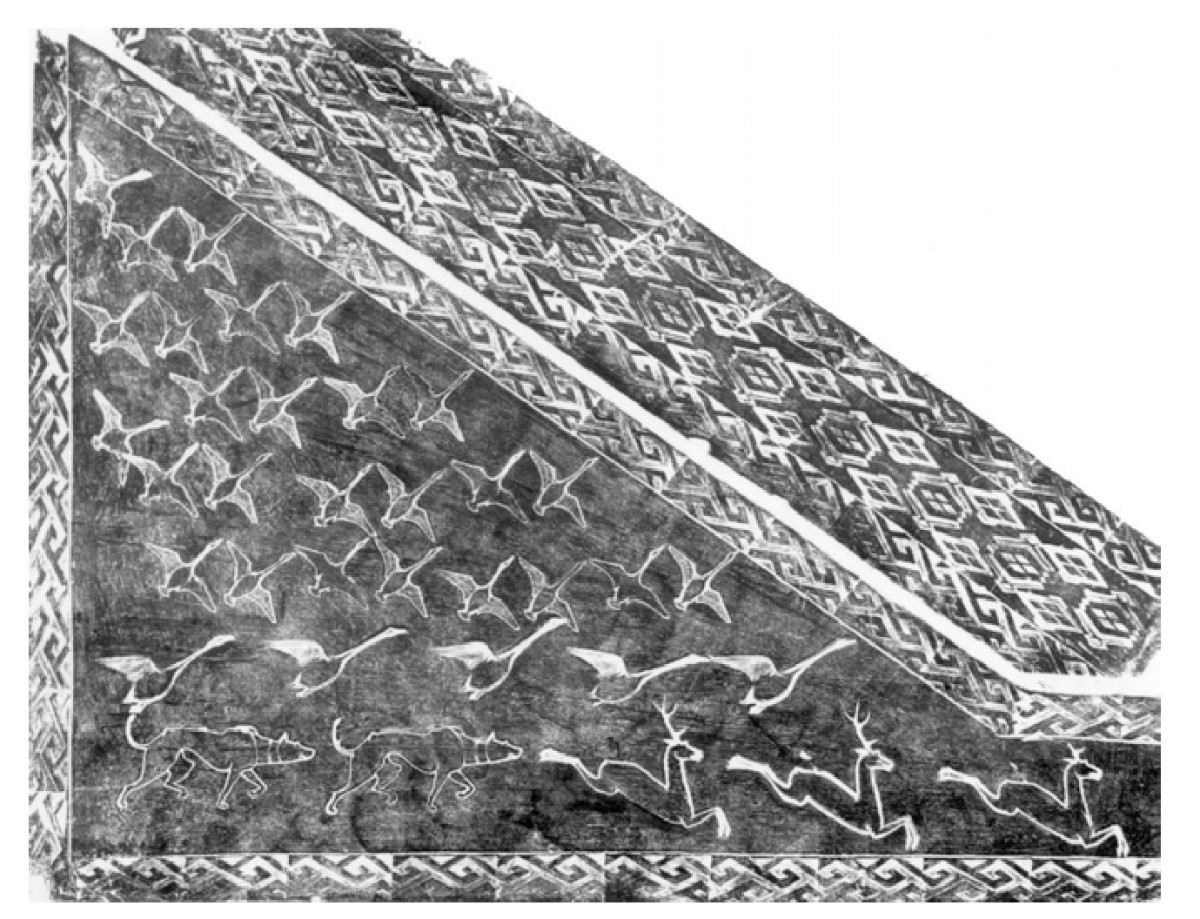
Chinese nobles likewise hunted with horses and dogs, and by the post-Shang period there was a clearly defined category of “hunting hound,” or liegou. During the Warring States period, the best dogs were believed to come from the small state of Han, south of the middle reaches of the Yellow River, and from the state of Yan in the northeast. Early Han tomb tiles even preserve images of large collared dogs in the characteristic stance of a pointer: their bodies slightly crouched, necks extended horizontally and one foreleg bent and raised above the ground, facing flocks of flying geese and running deer. Hunting dogs were sufficiently numerous and important at Shanglin that an official known as the Goujian, or “inspector of kennels,” supervised the breeding and training of dogs for the Han court.
This dependence on locally bred hunting dogs did not last indefinitely. By the beginning of the Common Era, different breeds were already moving across Eurasia. By the early modern period, the exchange of hunting dogs had reached an enormous scale.
How Dog Breeds Spread Across Eurasia
The scale and intensity of this movement can still be seen in the names of guard and hunting breeds, many of which refer to their actual or supposed places of origin. English contains names such as the Russian wolfhound, Irish setter, Great Dane, spaniel, Scottish terrier, Siberian husky, German shepherd, Afghan hound, Komondor — or Qumandur — and the Alan, a French wolfhound. The list could be extended considerably. The broader point is that dog breeds, many of them developed as hunting assistants, travelled widely across Eurasia in a process that began in early historical times and continues to this day.
Greyhounds and Salukis were among the first breeds to spread widely. From centres in Egypt and Mesopotamia, they reached the Mediterranean world during the Minoan period and later southern Europe under the Greeks and Romans. In subsequent centuries, these imported dogs — known in the Latin West as leporarius or veltre — were extensively bred and adapted. European whippets and wolfhounds are descended from the sighthounds of West Asia.
In Iran and Afghanistan, the greyhound became the region’s leading hunting dog. Known as the “Arabian” or tāzī hound, it was considered an appropriate princely gift. The Iranian form probably contributed to the development of the Russian Borzoi, essentially a larger sighthound with a heavier coat adapted to severe northern winters. The name, first recorded in Russian sources in 1613, comes from the Old Slavonic br’z’, meaning “quick” or “swift.”
The nomadic peoples of the Eurasian steppe had long possessed their own dogs, some of which were used in hunting. Their main function, however, was to protect livestock and camps from wild animals and human attackers. Dogs specifically bred for the chase therefore had to be imported from neighbouring sedentary societies. Unsurprisingly, the sighthounds of Iran and Afghanistan proved particularly well suited to the steppe’s open terrain.
Greyhounds that had changed little from their ancestral type could still be found among Kazakh nomads in 20th-century Dzungaria. Linguistic evidence suggests that these Inner Asian sighthounds were far from recent imports. The hunting hound is called tayghan in Middle Turkic, tayig-a in Mongolian and taiha in Manchu. These forms have been traced to the Middle Persian tāchik, meaning “Arab,” a term that later came to refer to settled Persian-speaking Muslims. For the peoples of Inner Asia, then, specialised hunting hounds were animals imported from outside the steppe and closely associated first with West Asia and later with the Muslim world.
The earliest evidence of greyhounds in China dates to the Han period. They appear frequently on pottery and bas-reliefs, sometimes depicted with remarkable precision while hunting hares and deer. They remained popular both as hunting dogs and as subjects of art through the Tang dynasty and beyond.
Over thousands of years, the greyhound became something close to a standard hunting breed across much of Eurasia. By modern standards, fashions in dogs changed slowly, but they did change. Regional enthusiasm for imported breeds can be documented at many points in history. One of the earliest examples is a Sumerian reference from around 2000 BCE to “princely dogs, the Elamite dogs.” During the Achaemenid period, large “Indian hounds,” particularly effective in hunting deer and wild boar, became highly fashionable. The taste for these dogs later spread westward during the Hellenistic age.
Mastiffs likewise experienced waves of popularity and travelled widely. Closely associated with mountainous areas such as Tibet, they were adopted in early China and may also have reached Assyria. Another surge of interest came in the late Middle Ages. Marco Polo wrote that Tibetans possessed the largest and hairiest mastiffs in the world, dogs supposedly capable of catching and killing all kinds of wild animals.
The early 16th-century merchant Ali Akbar Khitai offered another glimpse of their reputation and geographical reach: “Tibetan dogs are extremely shaggy and imposing, and their faces possess a dignity equal to that of a lion. At the exalted courts of [Muslim] rulers toward the lands of the Sultan of Rum [the Ottomans], there are dogs of this kind, which the people of Rum call the ‘Sasanian dog,’ although it is Tibetan in origin. These Tibetan dogs are found in the mountains of China, and it is from there that they are obtained.”
Roughly a century and a half later, an English version of the same type of dog became fashionable and caught the attention of the Mughal emperors, even though their empire directly bordered Tibet — a striking illustration of the way distance itself could add prestige to an animal.
Medieval Western Europeans readily adopted and modified foreign breeds. In doing so, they developed an impressive range of indigenous scent hounds capable of tracking, flushing and pursuing prey by smell and sound. Dogs trained to retrieve or point were not entirely unique to Europe, but no other region produced so many specialised hunting breeds, each suited to a particular type of landscape or quarry.
These European dogs first began moving east during the Carolingian era, when they were presented as princely gifts to Muslim rulers. Another wave came in the 12th century with the Crusades, when European bird dogs were introduced into the Holy Land. In Arabic they were called zaghārī, perhaps derived from the German Zeiger, meaning “pointer.” They appear to have attracted considerable attention among the hunting elites of the Middle East.
During the subsequent Mongol period, European bird dogs — possibly retrievers known as da paisa — reached China. In the post-Mongol era, Western scent hounds became firmly established at the courts of the central Eurasian states, frequently arriving as gifts from European merchants.
Although powerful courts had always received some foreign hunting dogs as diplomatic presents, certain rulers were not prepared simply to wait for exotic animals to arrive. They actively sought out new breeds from distant countries.
The Mughal emperor Jahangir was particularly fascinated by Western hounds. On one occasion, he asked Shah Abbas for “large European hunting dogs,” probably mastiffs. The Safavid ruler obtained nine and sent them to him. Jahangir later repeatedly pressed the English ambassador Sir Thomas Roe to provide hunting dogs. On one occasion, he specifically requested mastiffs, Irish greyhounds “and other dogs that hunt in your lands.”
By the end of the 17th century, John Ovington observed growing demand for European dogs during his stay in Surat. Spaniels used to hunt waterfowl were especially prized, while Irish wolfhounds and mastiffs were equally desirable. Two Mughal nobles even became involved in a fierce dispute over ownership of one such dog.
Yet these imported breeds never displaced local sighthounds. European dogs remained expensive and scarce because they struggled in unfamiliar conditions. Climate, disease and unfamiliar native wildlife all took a heavy toll on animals brought to the Indian subcontinent.
The workings of this vast canine exchange network can also be seen in 16th-century Russia. Russian rulers regularly gave birds of prey as diplomatic gifts and, in return, received hunting dogs from places as distant as Persia, Georgia and England.
By the second half of the 17th century, the Mughals were known to acquire “fine sporting dogs from the Uzbeks of every kind.” Yet as noted earlier, the nomads themselves had not developed many specialised hunting breeds, meaning that these animals almost certainly originated even farther north, in Russian lands.
Evidence from 1675 supports this interpretation. Acting on the advice of Indian merchants in Moscow, the Romanov court concluded that the best way to open trade negotiations with the Mughal Empire was to send gyrfalcons, Borzois and mastiffs as gifts. The merchants argued that the present would be particularly welcome because Indian rulers bought such dogs in Iran at high prices, while the Safavids themselves obtained the prized animals from Moscow.
Russia also helped supply foreign hunting dogs to the Qing dynasty. Lev Izmailov’s embassy of 1720 brought twelve Borzois and twelve French hounds as gifts to the Manchu court. Some were intended for the chief minister, but most were presented to the emperor. According to the Scottish traveller John Bell, every dog was formally catalogued: its name and distinguishing features were entered into official records, and a yellow silk collar was placed around its neck to signify imperial status.
The exchange of dogs as gifts and tribute, so well documented in the early modern period, was hardly a new phenomenon. Such exchanges had been taking place for at least a thousand years and were clearly one of the principal mechanisms by which specialised breeds spread across Eurasia. Over time, they created enormous diversity in the kennels of the continent’s great courts.
Tang China provides a vivid example. Court records show that dogs arrived as diplomatic gifts from Kucha, Samarkand, Ferghana and the Eastern Roman Empire, known in Chinese sources as Fulin. Most were hunting hounds, but some were tiny Mediterranean lapdogs trained to perform tricks and presented by the oasis state of Turfan.
Hunting Animals as Symbols of Prestige
The centuries-long fascination with other peoples’ dogs was driven in large part by the belief that animals from distant lands must possess exceptional qualities. Stories repeatedly circulated of bigger, stronger and more capable breeds supposedly living in some remote corner of the world.
At different times, the Canary Islands, Caucasian Albania and Afghanistan were all believed to be home to unrivalled hunting dogs, some allegedly so large and powerful that they could kill lions. The persistence of such stories from antiquity into the early modern period reveals the enduring fascination of aristocratic hunters with foreign breeds — and the prestige attached to owning them.
To some extent, imported dogs could be bred locally. Dogs are exceptionally adaptable animals, and self-sustaining populations of breeds such as greyhounds and mastiffs were eventually established across the continent.
This was possible only with genuinely domesticated hunting companions — dogs, horses and ferrets. Trained wild animals presented a different problem. Hunting cats, birds of prey and elephants could be carried far beyond the regions in which they naturally lived, sometimes expanding their cultural presence over enormous distances. Their natural geographical ranges, however, did not expand with them.
That difference had an obvious economic consequence: while successful imported dog breeds could eventually reproduce locally, the great courts of Eurasia remained dependent on long-distance trade and diplomatic exchange to replenish their stocks of trained wild hunting animals.
