


How Mao and Stalin Redrew the Map of Xinjiang
By 1949, after an exhausting struggle against the Nationalists, the Chinese Communist Party (CCP) had secured final victory across mainland China. The country’s new rulers found themselves facing a wide variety of political and cultural landscapes, which required different approaches to controlling and transforming local societies. Unsurprisingly, the greatest challenges arose in frontier regions such as Xinjiang, Tibet, and Inner Mongolia, where non-Han peoples made up the majority of the population. The existing literature on the Communist takeover has largely focused on predominantly Han regions, leaving the impact of the 1949 revolution on China’s ethnic minorities relatively unexplored. Qazaqstan Tarihy examines the CCP’s entry into the northwestern frontier region, known as the “peaceful liberation” of Xinjiang, treating it not merely as a political transformation but as a profound sociocultural process.
Source: James Z. Gao,
“The Call of the Oases: The “Peaceful Liberation” of Xinjiang, 1949–53”
A Frontier History and the Goal of Assimilation
The Xinjiang frontier came under Manchu control in the seventeenth century as a result of military expansion. Indigenous peoples such as the Kazakhs and Uyghurs lived in small, isolated communities at the time. Xinjiang’s capital, Dihua (present-day Urumqi), was founded in 1763. The first Han merchants arrived alongside the Manchu army and quickly discovered opportunities for trade and exchange.
By naming the city Dihua (qidi jiaohua, meaning “to enlighten and educate”), the Qianlong Emperor embedded an assimilationist objective in the new settlement: he hoped that the municipal government would not only administer the territory but also educate and assimilate the indigenous population. For a long time, Dihua remained a frontier zone where local cultures encountered newcomers, while most indigenous communities continued to live in the many isolated oases of the Tarim Basin.
The Paradox of Detachment and the Strategy of Nominal Loyalty
Xinjiang’s geography and cultural landscape shaped its unique position. Historically, the oases of Xinjiang were oriented “outward, across the borders” rather than inward toward one another. Communication between the oases was weaker than their ties with the outside world: the southern Tarim Basin was influenced by India, the north by Western Turkestan, the northwestern areas looked toward Central Asia, and only the eastern part was closely connected with China.
China had long been characterized by a center-periphery divide, with China proper dominating frontier regions such as Xinjiang and Tibet. From the perspective of Xinjiang’s inhabitants, however, it was China proper that constituted the periphery; events there were of only “marginal importance” to them. Neither the 1911 Revolution nor the Sino-Japanese War of 1937–1945 directly affected Xinjiang, and much of the population viewed changes of regime in China proper with cynicism.
Local Han officials developed their own survival strategy. Xinjiang’s first Republican governor, Yang Zengxin, who had little regard for the governments in Beijing, followed the principle of “worshipping the temple, but not the gods within it.” In practice, this meant being prepared to deal with whichever new government came to power in Nanjing or Beijing. Recognition of the central government strengthened the authority of Han officials over the indigenous non-Han population and legitimized the persecution of rivals and political dissidents. Moreover, since the Qing dynasty, local military supplies and the provincial budget had depended on financial support from the center. The strategy proved successful in preserving the local government’s legitimacy while avoiding direct conflict with China.
The Warlord Era and the Explosion of Ethnic Distrust
During the Republican era, poor transport and communications, combined with declining financial support from the Nanjing government, separated the “new dominion” from the rest of China and turned it into an “autonomous appendage of the Chinese state.” The Han warlord Sheng Shicai ruled Xinjiang for eleven years, building his own despotic kingdom.
In 1934, when Chiang Kai-shek was planning a military expedition against Sheng, mobilizing 150,000 troops and 15 million yuan, he was informed that there was no way to guarantee adequate supplies of food, water, and fuel for the army. When Sheng learned that the campaign had been cancelled, he remarked that Chiang Kai-shek could do nothing to him because he was “too far away to reach.” After Sheng left Xinjiang, Chiang appointed him minister of agriculture, explaining that despite his brutality, Sheng “had not declared independence from Nanjing and had not allowed the Russians to annex Xinjiang.”
Replacing one Han warlord with another did nothing to change the conditions that fueled distrust, resentment, and rebellion among the non-Han population. Han provincial governments in Xinjiang struggled to extend their authority into rural areas. Heavy taxation and forced labor provoked repeated uprisings among Uyghurs and Kazakhs. As a result, the term “Han” became synonymous with oppression and corruption. Seeking to “compete with the Han,” the inhabitants of the oases developed a “new Uyghur ethnic identity.”
Cooperation with Local Elites
At the same time, the history of the frontier was also a history of cooperation and assimilation. Dihua was becoming increasingly Sinicized, while growing numbers of Uyghurs came to the city to study, conduct business, and participate in politics. Han rulers were compelled to seek allies among the indigenous population, pursuing a strategy of “controlling the situation through Islamic imams.”
In the 1940s, the Nationalists began recruiting young urban intellectuals into the administration. Burhan Shahidi, regarded as a man with a “strong sense of his homeland [China],” was appointed provincial governor. Saifuddin Azizi, a pro-Chinese Uyghur, became provincial commissioner of education. Such appointments, however, did not alter the Nationalist conviction that real power should always remain in the hands of Han military leaders.
The Struggle for Influence and the Ili Rebellion
Xinjiang’s history in the first half of the twentieth century was marked by warlordism and growing foreign influence. As on any frontier, several outside powers were active there, including Turkish, Russian, and British forces and interests. Because these powers remained in constant competition, none was able to establish lasting hegemony.
The Ottoman Empire initiated a campaign of cultural influence. As early as 1915, primary schools were opened in Kashgar where children were taught Islam and Pan-Turkist ideology. Propaganda pamphlets were also circulated. Following the Bolshevik Revolution, the Russians opened schools in Dihua, exported books, newspapers, and films, and developed special radio programs for the local population.
The growth of Russian influence resulted from two contradictory strands of Soviet policy. The first involved supporting Han-dominated governments in order to secure political and commercial privileges. The second involved encouraging anti-Han uprisings among Kazakhs or Uyghurs in order to establish Soviet-backed centers of power. In 1944, the USSR initiated and sponsored the Ili Rebellion, also known as the “Three Districts Revolution,” in an attempt to transform an anti-Kuomintang uprising into a socialist revolution.
The Russians soon discovered, however, that strong Pan-Islamist and Pan-Turkist sentiments existed among the rebels. One unintended consequence was that the Muslim independence movement in the “three districts” began to threaten the legitimacy of Soviet domination over the USSR’s own Muslim minorities.
The Polarization of Intellectuals in Dihua
During the first half of 1949, as the People’s Liberation Army advanced rapidly, the Nationalist government in the northwest was approaching collapse. In Dihua, students and intellectuals split into pro- and anti-Soviet camps. During a screening of the Soviet film Admiral Ushakov, which depicted wars between Imperial Russia and the Ottoman Empire, for example, pro-Turkish students reacted enthusiastically to Turkish victories, while pro-Soviet students cheered the destruction of the Russian fleet. The screening ended in a brawl.
Professor Isa Yusuf Alptekin advocated the creation of an independent Islamic state in Xinjiang, arguing that “Xinjiang is the home of the Uyghurs, while all other nationalities are foreigners.” He emphasized the ethnic and cultural unity of Central Asia’s Turkic-speaking Muslims, which displeased the Soviets. The Russian consulate reported that Isa had discussed the possibility of an independent Islamic state with Ma Bufang and maintained close ties with the British consul, adding that “American imperialism was very active among the Uyghur people.”
Stalin’s Geopolitical Imperative and the Policy Shift
The strengthening of the Uyghur separatist movement in 1949, together with growing Western influence, posed a threat to the Russian position in the region. Moscow could not allow Xinjiang to emerge as an anti-Soviet base, yet it could suppress the movement neither through the Ili regime nor through direct military intervention.
The Soviet leadership therefore concluded that a change of policy was necessary. Although Moscow had previously persecuted those who attempted to establish contacts between Ili—the local government of the Ili district—and the CCP, including Abdul Karim Abbasov, in June 1949 Moscow suddenly demanded that the CCP send a representative to Yining to establish effective communications with the Ili regime. In September, Moscow went further, asking the CCP to incorporate the Ili regime’s military forces, the National Revolutionary Army, into the PLA.
Archival documents indicate that Russia’s principal objective was to hand the “complex political and ethnic problems of the frontier” over to the Chinese Communists. The PLA’s military successes in China proper convinced Moscow that it was capable of “taking on this hot potato.”
From the perspective of Soviet security, a region controlled by Han Chinese Communists would follow the Soviet model of a multinational state and could suppress Pan-Turkist and anti-Soviet rebellions, thereby strengthening both Chinese and Soviet territorial security. Stalin criticized Mao for hesitating and urged him to send the PLA into Xinjiang as quickly as possible, promising military support, including the use of the Soviet Air Force. He also advised Mao to radically alter the region’s demographic landscape by increasing the Han share of Xinjiang’s population from 5 percent to 30 percent through mass migration, thereby strengthening Communist control.
Accelerating the Military Plan and Pursuing Negotiations
Mao Zedong’s original plan called for a military advance into Xinjiang no earlier than the spring of 1950. After the decisive victory in western Shaanxi in July 1949, however, Mao ordered Peng Dehuai to change the plan and “occupy Dihua in the winter [of 1949].” Following the fall of Lanzhou, Mao instructed the PLA’s Second Army under Wang Zhen to move rapidly westward and block the road into Xinjiang. The accelerated timetable, encouraged by Stalin’s criticism that Mao had overestimated the strength of Muslim cavalry forces, forced PLA soldiers into relentless and exhausting marches.
Mao nevertheless hoped for a peaceful settlement and used Zhang Zhizhong to organize a Xinjiang Military-Political Committee as a transitional institution. Zhang Zhizhong, anticipating inevitable defeat, had refrained from building fortifications along the Xinjiang-Gansu border and later urged the Nationalists in Xinjiang to “formally announce a break with the Nationalist government in Guangzhou and join the democratic people’s camp.” Encouraged by Moscow, the Ili regime declared its willingness to join the Chinese revolution, a move warmly welcomed by Mao.
Overcoming Hard-Line Resistance
General Tao Zhiyue, commander of the Nationalist forces in Xinjiang, also wanted to defect to the Communists but feared the Russian-backed Ili regime. Burhan, who had ties with both the Russians and the CCP, guaranteed Tao’s safety. From Beijing, Zhang Zhizhong persuaded Tao that the best moment to revolt would be “before the establishment of the Central People’s Government.”
The key to a peaceful solution was persuading the hard-liners who controlled three-quarters of Xinjiang’s armies, including commanders Ye Cheng, Luo Shuren, and Ma Chengxiang. Tao spent two months negotiating with them, arguing that continued resistance would mean that “thousands of officers and soldiers would die in vain, the people of Xinjiang would lose their homes, the various ethnic groups would begin killing one another, and we would be unable either to fight or to seek peace.” Tao offered to let them surrender their troops and leave Xinjiang with their money, while guaranteeing their safety.
The Factors Behind the Final Collapse
Tao’s arguments were reinforced by two incidents that demonstrated how quickly continued resistance could descend into chaos.
The first was the brutal murder in Lanzhou of eleven members of the family of Sheng Shicai, the former warlord, by his former subordinates, who were seeking revenge for friends and relatives. As soon as the news reached Dihua, Uyghurs organized a delegation led by Isa to welcome and protect the killers. Isa argued that Sheng had deserved his punishment, clearly suggesting that revenge killings could also take place in Xinjiang.
The second was the looting and rape of Yinchuan by Ma Hongkui’s cavalry. After being defeated, the troops lost discipline, plundered shops, raped women, and burned houses.
Beyond the moral collapse, Tao and the hard-liners understood that they could no longer compel their soldiers to fight. The central government had stopped all supplies, and the troops had gone unpaid for months. Inflation and currency depreciation had spiraled out of control; a junior officer’s monthly salary was enough to buy only a couple of packs of cigarettes. The situation was made still worse when Ma Bufang fled to Hong Kong, taking with him $50,000 in military funds.
With neighboring forces capitulating—for example, 30,000 Nationalist troops surrendered at Jiuquan on September 24—Tao Zhiyue and Burhan Shahidi decided on a “peaceful uprising.” The Han and Islamic chambers of commerce, along with the Dihua municipal congress, supported them. At the last moment, Tao managed to persuade Ma, Ye, and Luo not to fight and escorted them out of Dihua.
On September 25 and 26, 1949, Tao and then Burhan sent open telegrams announcing that they were severing all ties with the Kuomintang, accepting Mao’s peace declaration, and were prepared to await further orders. This became known as the “Xinjiang Peaceful Uprising.” Martial law was imposed on September 28, and public order in Dihua was quickly restored.
The Invasion and Its Logistical Challenges
The success of the peaceful uprising strengthened Tao’s confidence in his ability to govern, and he sent a representative to Peng Dehuai asking that the PLA not enter Xinjiang during the winter of 1949–1950. Mao ignored the request and ordered Peng to prepare for the advance in early or mid-November.
The PLA dispatched the Second and Sixth Armies and the Fifth Mechanized Regiment to Xinjiang, a combined force of 90,000 personnel. They were supported by 760 trucks, 589 camels, and large stocks of food, fuel, and medicine. The Soviet Union supplied 40 transport aircraft to airlift some of the troops.
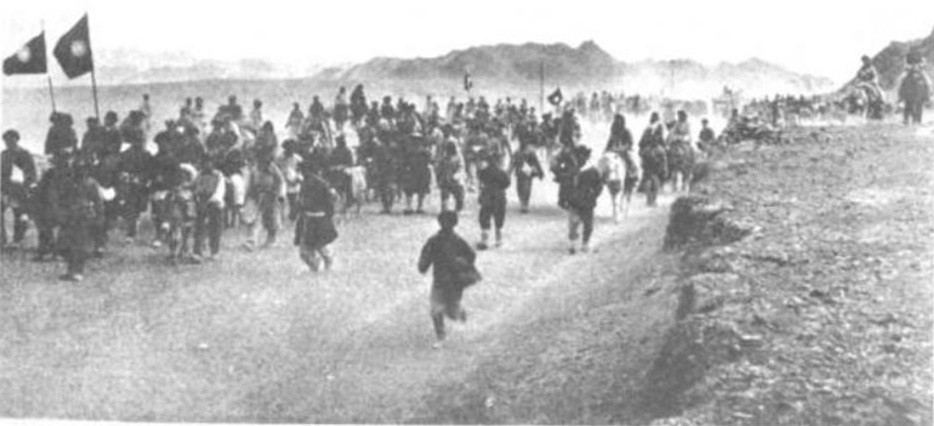
On November 10, 1949, the first group of PLA soldiers set out. They crossed deserts and snow-covered mountains, covering 1,253 kilometers (779 miles) in ten days before reaching Dihua, where 50,000 residents lined the streets to greet them.
The PLA’s march through the remote frontier presented extreme difficulties that most soldiers from China proper could scarcely have imagined. Headquarters reprinted a Kuomintang booklet titled Introduction to Transportation in Xinjiang and distributed it among the troops. It offered practical advice, such as planning desert stops according to the availability of water and fodder rather than the distance travelled. It listed every river, stream, and well, and even villages consisting of just five to ten households.
The 15th Regiment began its march from Aksu to Hotan across the Taklamakan Desert, a journey of 247 miles. The manual included the legend of the “Pigeon Dam,” where a pigeon supposedly showed General Zhou Wen the way after he became lost among shifting dunes during the Qianlong era. It also recalled how, in 1932, Kuomintang soldiers refrained from harming pigeons even while burning Uyghur villages. Such Han stories reflected a fear of the inhospitable non-Han frontier, where survival appeared to depend on the blessing of gods or mysterious pigeons. In 1949, the soldiers endured cold, wind, and sandstorms.
Overcoming Ethnic Distrust Through Discipline
The Communists believed that crossing the “deadly desert” required not pigeons but reliable Uyghur guides. Yet despite their hostility toward the Nationalists, Uyghurs did not trust the newly arrived Han soldiers, and few were willing to serve as guides.
The PLA relied on strict discipline to demonstrate that it was different from the Nationalist army. Nationalist troops had demanded food and accommodation from local residents. PLA soldiers, by contrast, ate their own rations and slept by the roadside. Wherever they went, the PLA built roads and bridges for both military and civilian use. Soldiers who arrived in Dihua during the winter immediately began preparing stone for road construction. By spring, many streets that had once turned into impassable mud had been paved. Residents were delighted to discover that the soldiers had become “builders of the city.”
By March 1950, the last troops had reached their positions along the northern frontier. The PLA immediately launched military operations against some 20,000 Kazakh rebels led by Masud Sabri and Janimkhan. The campaign was accompanied by mass rallies at which the rebels were denounced as “Muslim traitors and American spies.” It ended with the defeat of the rebel forces and Masud’s capture in July, while 16,400 Kazakh herders were returned to peaceful life.
Laying the Foundations of the New Order
As part of the occupation, the PLA also carried out political and cultural programs. Language initiatives were successfully introduced in Kashgar, where Uyghurs were taught Chinese and Han cadres learned Uyghur, contributing to the emergence of the first generation of Uyghur cadres. The CCP began recruiting new party members among the indigenous population through a “top-down” approach: cities first, followed by the countryside; revolutionary intellectuals first, followed by workers and peasants. On December 23, 1949, fifteen local leaders, including Burhan and Saifuddin, joined the CCP and became junior members of its governing institutions.
At first, the Communists exercised considerable caution toward the indigenous population and its religious practices. Later military and political campaigns, however, guided by the theory of class struggle, “caused considerable numbers of innocent Uyghurs to suffer,” disrupted their traditional way of life, and created new tensions in ethnic relations along the frontier.
The PLA took pride in its “magnificent” march. Unlike the Qing court’s expedition of 1874, which had required more than two years to occupy the province, the PLA’s 90,000 troops established effective control over all of Xinjiang within six months.
The Economic Factor and the Policy of Tunken Shubian
Logistical support remained a decisive issue. As an impoverished frontier province, Xinjiang could not feed the dramatically expanded military presence, and local governments began to complain. In response, the PLA was forced to become self-sufficient by producing its own food and clothing, leading to the decision to develop military farms.
This policy was intended not only to solve the PLA’s economic problems but also to secure and develop the frontier. It reflected the longstanding Chinese practice of tunken shubian (“stationing troops to cultivate wasteland and defend the frontier”). In essence, it was an imperial policy for retaining newly conquered territory through military settlement. Wang Zhen insisted that the PLA establish new oases in the desert rather than “compete with the indigenous population for land.” The plan envisioned farms beginning with agriculture and subsequently developing industry, commerce, various services, and education.
The Elimination of the Ili Regime
Despite the success of the peaceful uprising, Mao Zedong was not prepared to tolerate the “relative independence” of any part of the frontier. The CCP Central Committee rejected the old Ili regime’s demand to “take control of the areas evacuated by the Nationalist Party,” stating that every military action had to receive Beijing’s approval.
The Ili regime, a Soviet-backed “state within a state,” was dissolved. Its military forces were transferred from the National Defense Army to the Production Corps (Shengchan jianshe bingtuan). The move reflected Mao’s wariness of Russian influence and ethnic tensions, as well as his determination to establish direct CCP control over the province.
Social Engineering: The Role of Women Soldiers
Many studies portray the conquest of Xinjiang as a “male story,” overlooking the contribution of women. Yet women’s participation was a crucial element in achieving the objectives of tunken shubian.
Wang Zhen believed that the PLA would be unable to establish a permanent presence on the frontier unless its soldiers formed families. He feared that in a “world made up only of men”—with nearly 100,000 Nationalist troops and almost 100,000 PLA soldiers in Xinjiang—the soldiers might turn into bandits. In addition, in order to prevent ethnic conflict, the Party prohibited Han men from marrying non-Han women.
In 1950, Wang Zhen appealed to the leadership of Hunan Province to recruit large numbers of women soldiers: “We welcome all educated, unmarried girls aged 18 or 19, regardless of their family background. We want them to come here to become good workers, good wives, and good mothers.”
The recruitment criteria made the underlying objective clear: the young women were expected to be unmarried or divorced, healthy, and to have “regular facial features” (wuguan duanzheng). Girls from landlord families and other “exploiting classes” were also accepted, as were those whose fathers had served the Nationalists, because military service offered them an opportunity to “cast off their old selves” and change the social standing of their families.
Arranged Marriages and the Stabilization of the Settlements
Even during the journey, the young women began to suspect the real motives behind their recruitment, since at every stop they were asked about marriage. Although rumors that they would be forcibly assigned to disabled men were exaggerated, marriages were arranged by the Party according to the principle that “the Party assigns, and the woman agrees,” though in practice there was little room for choice. Because the men were subject to strict eligibility requirements—for example, they had to be battalion commanders or platoon commanders aged at least 26 with five years of service—husbands were often 10 to 20 years older than their wives.
The women performed a wide range of jobs, including teaching and nursing. All women soldiers with secondary education became teachers as the PLA launched a literacy campaign requiring every soldier to learn to read and write. They also provided essential domestic services, including laundry and personal care. Women who arrived after 1952 were mainly assigned to agricultural labor, sharing all forms of heavy work with the men, including chopping firewood, plowing, and fighting locust infestations.
The leadership ordered that the burden on young mothers be reduced. Any non-combatant mother who had given birth to and was raising three or more children received all the benefits available to PLA soldiers.
Women made a substantial contribution to the growth of the new oasis farms. At the same time, these farms developed into self-sufficient and isolated communities with limited contact with Uyghur farmers. Communist farms rejected Uyghur men who wanted to marry Han women soldiers—for example, some Uyghurs reportedly offered four hundred sheep in exchange for several women—because the PLA would not allow its women to marry anyone who was not “one of their own people.” The presence of Han women thus made the farms “an even more exclusive world of Han Chinese.”
In 1953, the Central Military Commission approved a five-year plan to bring another 99,300 women from China proper to Xinjiang in order to resolve the gender imbalance once and for all. The arrival and settlement of these women stabilized life on the frontier and helped the PLA achieve the objective of the “peaceful liberation” of Xinjiang.
Establishing a New Form of Domination
The events in Xinjiang between 1949 and 1953 cannot be explained solely through the theory of class struggle. The PLA’s arrival was in many respects an unforeseen development, while the peaceful settlement resulted from negotiations among competing forces rather than from the wisdom of a handful of political leaders. The “peaceful liberation” replaced the Nationalist regime with a more effective form of domination.
The PLA functioned as an “armed body for carrying out the political tasks of the revolution,” extending state control into territories that neither the Manchus nor the Nationalist Party had ever reached. The military settlement system of tunken shubian, originally an imperial policy for retaining conquered territory, became a permanent institution through the migration of women from China proper, who made family life possible for the soldiers.
Although Mao accepted military assistance and demographic advice from Stalin, he did not fully follow the Russian model and moved quickly to dismantle the Ili regime. The success of the PLA farms encouraged migration from China and transformed Xinjiang’s demographic landscape. From that point onward, the state continued to transfer workers and their families to Xinjiang alongside the relocation of factories and the development of oil fields.
