


How Religion Shaped Colonial Policy in Kazakhstan
At the turn of the nineteenth and twentieth centuries, the territory of present-day Kazakhstan became one of the key spaces of Russian colonial policy. The Steppe Region, where Islam was part of everyday life and nomadic culture shaped the social order, was incorporated into an imperial model of governance based on the promotion of Orthodoxy, settled life, and Russian identity through the resettlement of large numbers of Russian peasants in the Kazakh steppe.
However, the mass influx of settlers only intensified tensions in the region and made its religious landscape more complex. The position of Orthodoxy, which officials viewed as a pillar of imperial control, was undermined not by Islam but by the growth of Protestant movements among the Russian settlers themselves. The Baptists, who began organizing actively after 1905, came to be seen by the clergy as a threat to the imperial mission, mainly because their preaching attracted Russian peasants who were supposed to serve as carriers of “Russian” and “Orthodox” identity on the empire’s frontier.
Aileen E. Friesen’s chapter “An Anthill of Baptists in a Land of Muslims” from Colonizing Russia’s Promised Land shows that the Kazakh steppe in the early twentieth century was an arena of complex competition within the Christian sphere itself. This raises an important question: why, under the conditions of colonization, did Russian Protestant movements—rather than Muslim communities—come to be perceived by the state as the main threat to Orthodoxy and loyalty in Kazakhstan?
Orthodoxy, Islam, and Sectarianism
Colonization brought the Orthodox Church many problems, but what alarmed it especially was the emergence in Siberia of a significant number of Slavic settlers who practiced non-Christian or non-Orthodox forms of Christianity. In 1913, Andronik, the Bishop of Omsk, complained about an “anthill of sectarianism” in the region. Local missionaries compared the spread of Baptism among settlers to an infection. By the end of the nineteenth century, officials and church figures increasingly equated the Orthodox faith with Russian national identity, while abandoning it was seen as a sign of political unreliability. Baptism caused particular concern, as it was growing stronger through German-speaking communities; the conversion of Slavs to this faith was interpreted as a cultural and political challenge to the integration of Siberia into the empire. In addition, the largest “non-Orthodox” community in the Omsk diocese was Islam, with almost one million followers. Although the tsarist authorities had traditionally used Islam for administrative purposes, by the early twentieth century suspicions had intensified that Muslim elites, inspired by Pan-Turkism and Pan-Islamism, might pursue political goals dangerous to the state. Kazakhs were considered Muslims only nominally, but this did not mean they were trusted: the authorities feared the strengthening of politicized Islam in the steppe.
Under the conditions of colonization, the issues of Orthodox settlement, sectarianism, and Islam became intertwined. For the authorities of the Omsk diocese, Orthodoxy became a key instrument for securing the region culturally and politically for Russia. Governor Troinitsky argued that Orthodox churches and settlers symbolically and practically consolidated Russian control: they blocked Chinese claims and resisted internal religious competitors. This was how, for example, the construction of a new cathedral in Pavlodar after the fire of 1901 was assessed—as the creation of an “Orthodox frontier” against Islam and sectarianism. Yet these strongholds faced serious challenges. Bishop Andronik and the missionary Ioann Vostorgov feared that Omsk, Tomsk, and Blagoveshchensk could become “sectarian citadels,” which would threaten both the Church and the state. Vostorgov referred to the fate of the Byzantine Empire, weakened by religious pluralism in its border provinces. He insisted that only Orthodoxy could keep Siberia within St. Petersburg’s orbit.
After 1905, the problem became more acute. During the political reforms, Nicholas II granted his subjects greater religious freedoms: people were allowed to leave Orthodoxy, though only for another Christian confession, and previously persecuted groups gained the right to hold meetings. This expanded the space for choice and radically changed the religious landscape. In the Omsk diocese, Muslims who had converted to Orthodoxy began asking to return to Islam, while Russian settlers sought to join the Baptists. The authorities now feared that the demographic Russification of the Akmola and Semipalatinsk regions could be undone by the mass conversion of Russian settlers to Protestant sects. Instead of strengthening Orthodoxy in a Muslim region, colonization could produce groups with unclear political loyalties.
The Kazakh Mission and the Challenges of Converting Non-Russian Peoples under Resettlement Policy
The Omsk diocese, like other regions with large numbers of people of other faiths, created an external mission intended to convert those who had never belonged to Orthodoxy. The Kazakh Mission performed this function: its structure took shape in 1895 from posts of the Tobolsk and Tomsk dioceses and covered the Semipalatinsk and Akmola regions, including two monasteries. Formally, its flock numbered about 13,000 people—almost all of them Russians and only around three hundred baptized Kazakhs. Thousands of Russian settlers also lived near the mission stations.
Interaction between Kazakhs and Russians complicated the missionaries’ work. The settlers themselves often had a poor understanding of the basics of the faith, which made it harder for the mission to present Orthodoxy to Kazakhs as a unified and strong confession. The lack of schools and churches alarmed the authorities: living among Kazakhs, settlers might adopt their way of life. Mission reports spoke of the need to “strengthen” the faith both among unstable Russians and among Kazakhs. At the same time, conversions of Muslims to Orthodoxy were extremely rare—only a few per year; conversions of Russians to Islam almost never occurred, unlike in some regions of Central Asia. Nevertheless, settlers actively used fear of Islam in their appeals to church authorities: they asked for schools and churches to be opened, claiming that their children were “beginning to imitate” Kazakhs. But such statements did not always reflect reality: many of these villages were located in the most Russified areas.
After the reforms of 1905, which granted freedom of conscience, the mission faced new difficulties: Kazakhs who had previously been baptized began submitting mass requests to return to Islam, claiming that they had been converted by force. Missionaries complained that the new laws gave an advantage to Muslim preachers, who were strengthening distrust toward Orthodoxy.
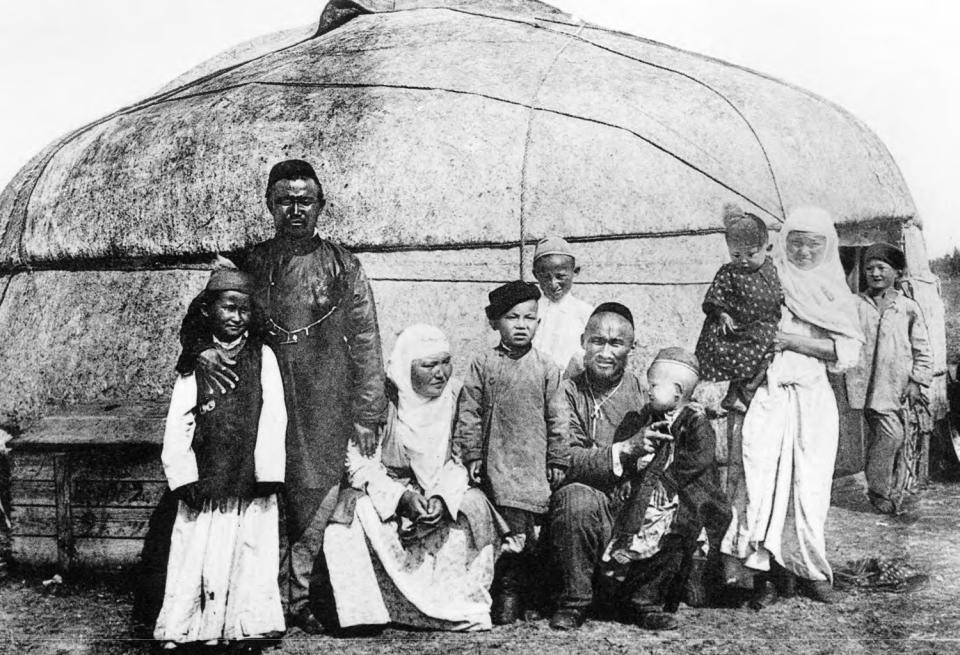
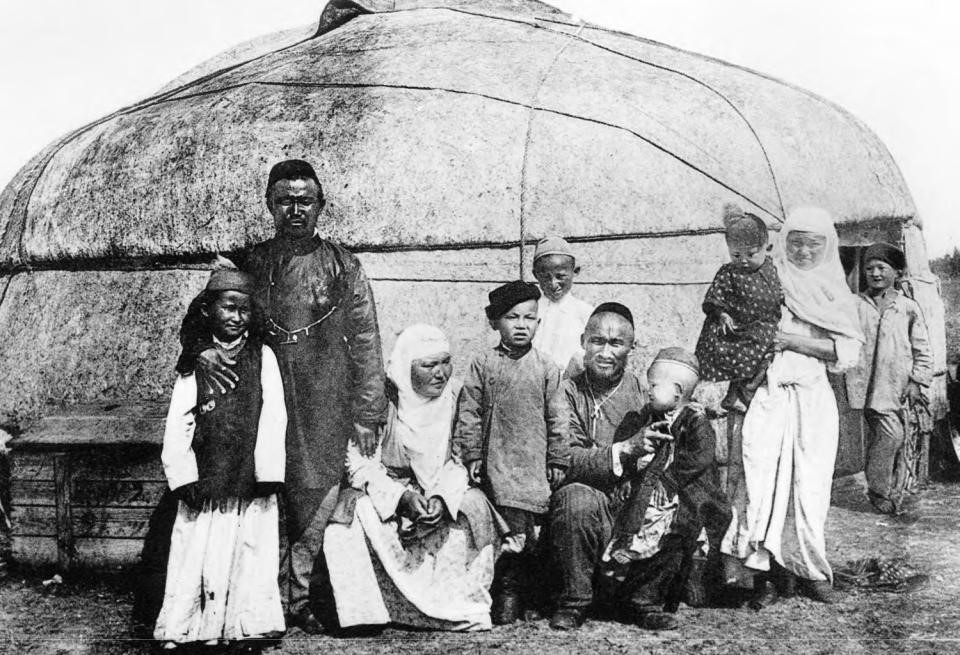
Muslim Kazakhs living on the steppe. INTERFOTO/Alamy Stock Photo.
In some official circles, there was a widespread belief that settling the region with a Russian Orthodox population would “civilize” the Kazakhs by making them more sedentary. In the early twentieth century, the governors of Akmolinsk and the Steppe Region, as well as Duma deputy A. Tregubov, supported the resettlement of Russians into Kazakh areas, believing that life among Orthodox Christians would push Kazakhs toward a settled way of life and later toward conversion to Orthodoxy. They argued that Kazakhs were only nominal Muslims and were more receptive to schools and the Church than other peoples of the Muslim world.
The Holy Synod hesitated at first, but in 1912 it approved the idea and passed it on to the Ministry of Agriculture, emphasizing that Orthodox Christians had to remain in the majority. The Resettlement Administration supported this decision, seeing it as a tool for integrating Kazakhs into Russian culture.
The Kazakh population protested sharply. In a petition to the Council of Ministers, residents of the Turgai Region accused the authorities of violating their own laws and demanded respect for the religious rights of Muslims. They noted that such a policy would not “civilize” Kazakhs but would only corrupt them, since Russian settlers were known for drunkenness—a vice absent among Muslims. These protests reflected the growth of political self-awareness among the Kazakh intelligentsia, which had been intensified by resettlement policy.
The renewed interest in converting Kazakhs against the background of resettlement reflected a change in the imperial climate. By 1910, the state had adopted a harsher attitude toward “foreign confessions.” Influenced by fears of Pan-Islamism, the government used sharp anti-Muslim rhetoric. Governor-General Schmidt warned the center that Tatar propagandists were linking the Kazakhs’ land crisis to Russian resettlement and calling for Muslim solidarity.
Unlike these politicized approaches, missionaries of the Omsk diocese more often wrote about everyday difficulties. After 1905, they increasingly doubted the success of their efforts. Local reports recorded isolated cases of Muslim conversion, but did not interpret them as politically significant.
In the diocese, Kazakhs also played a symbolic role. In sermons and pastoral instructions, priests contrasted them with Russian settlers, using images of the “alien” or the “wild” to criticize the irreligiosity of Orthodox believers themselves. During pastoral tours, Bishop Andronik compared Russian children’s ignorance of the faith to “living like Kazakhs.” Clergy also presented the settlement of the steppe as the transformation of a Muslim space into a Christian one through the arrival of Russians. Describing changes in the Akmola Region, they emphasized that only recently it had been inhabited by nomads, while now churches stood on this land as signs of the victory and presence of Orthodoxy.
The Growth of Sectarianism in the Omsk Diocese and the Responses of the Church and State
Siberia had long served as a refuge for groups whose religiosity the state regarded as “questionable.” Since the schism of the seventeenth century, Old Believers had taken shelter there, creating stable autonomous communities removed from direct Church control. By 1911, there were almost 22,000 Old Believers in the Omsk diocese, with especially large numbers in the hard-to-reach Bukhtarma region. Although Orthodox clergy considered them less dangerous than Baptists, their deep roots in the region still caused concern.
The Old Believers were joined by Baptists, Molokans, Dukhobors, and other groups. “Schismatics” usually referred to Old Believers, while “sectarians” meant those who had consciously left Orthodoxy. Local clergy insisted that before the arrival of Russian settlers, Siberia had been “clean” of rationalist sects. Now, however, Pavlodar and other settlements had become breeding grounds for alternative forms of religiosity—according to priests, entirely because of the settlers.
By the early twentieth century, the diocese’s attitude toward sectarians had become almost fatalistic. In 1907, Bishop Gavriil complained that sectarianism was growing “by leaps and bounds.” Its spread was helped by the absence of restrictions on the resettlement of people of other faiths: convinced preachers traveled with the migrant flow, spreading their ideas at railway stations and in settlements. Priests complained that it was impossible to forbid them from coming to Siberia, while the settlers themselves saw the region as a convenient place for religious freedom.
Government authorities discussed the need to control the confessional composition of migrants, but such restrictions were difficult to implement effectively. Baptists hid their affiliation, and data on religious identity was poorly collected. The metaphor of “infection” became fixed in the discourse: the only form of prevention was believed to be isolating Orthodox believers from “contamination” by sects.
One of the main channels through which sectarianism spread was the railway. The stations of Chelyabinsk, Omsk, and Petropavlovsk turned into “strongholds” of the movement: libraries, missionary groups, and active preachers operated there. The sect also had a network near the Trans-Siberian Railway, where public debates took place between Orthodox missionaries and Baptist leaders such as Gavriil Mazaev.
Statistically, the situation did not look catastrophic: according to data from 1910, there were around 8,500 sectarians in the Omsk diocese; in the Akmola Region, Baptists made up less than 1% of the population, while “rational sects” accounted for only 1.35%. At the same time, 57% of the population was Orthodox and 38% Muslim. Data for Semipalatinsk is absent, but there Muslims made up the majority.
To combat the loss of believers, the diocese created internal missions. At the Clergy Council of 1899, missionary positions were established for work with Old Believers and sectarians, along with a special library. In 1910, Omsk asked the Synod to allocate funds for another missionary in Semipalatinsk, citing the growth of Baptism.
Secular officials strongly shaped how the capital perceived Siberia. The greatest influence came from Governor-General Schmidt, who in 1910 sent St. Petersburg a sharply worded report on the “sectarian threat” and the weakness of the Church. He accused local priests of being unprepared and passive, which made Orthodox peasants easy prey for Baptist preachers. Schmidt argued that freedom of conscience was undermining the empire: the Russian state remained strong only as long as the peasant remained Orthodox.
Schmidt’s report alarmed Nicholas II. At Stolypin’s initiative, A. Kologrivov, an official from the Ministry of Internal Affairs, was sent to Siberia and confirmed Schmidt’s conclusions: sectarianism was not only a religious threat but also a national one. Kologrivov claimed that a Russian who rejected Orthodoxy lost the “Russian soul,” became indifferent to state interests, and adopted German accents and pacifism. He believed that the Akmola and Semipalatinsk regions were especially “infected” with Baptism, and that colonization would only intensify the process.
Kologrivov also criticized local priests and police for their inability to resist the sectarians. He demanded restrictions on the activities of movement leaders, especially Mazaev, and insisted on repressive measures against illegal gatherings and “blasphemy.” It was proposed that the police be trained to deal with religious violations.
After the 1905 Revolution, the number of official departures from Orthodoxy increased. In Pavlodar district, entire villages asked for permission to become Baptists. In the Akmola Region in 1913, 432 people submitted petitions to leave Orthodoxy; the year before, there had been 1,218 such petitions, of which 1,193 were to join the Baptists. These figures worried the center: the Holy Synod demanded explanations.
Bishop Vladimir replied that he had long warned about the growth of sectarianism. He pointed to the shortage of parishes, the lack of missionary training, the weakness of the clergy, and even the interference of Ioann Vostorgov. He accused graduates of Vostorgov’s pastoral courses of having personal qualities that alienated parishioners and pushed them into sects. The new Baptists, however, explained their conversions not by the behavior of priests but by the appeal of the Baptist interpretation of the Bible.
Missionary Congresses of 1910 and the Administrative Restructuring of the Omsk Diocese
In 1910, as Governor-General Schmidt was raising the issue of the “sectarian threat” in the Omsk diocese before the capital, the Russian Orthodox Church held two major missionary congresses, in Kazan and Irkutsk. Representatives of the Omsk diocese also attended the Kazan congress, which was devoted mainly to the external mission among non-Russian peoples. There, participants discussed the translation of religious literature into local languages, the opening of schools for Indigenous peoples, the publication of anti-Muslim brochures, and the organization of parishes.
Through this forum, the Omsk delegates became part of the empire-wide discussion about mission among Muslims—in Turkestan, the Tobolsk diocese, and the Kazakh steppe. Bishop Gavriil chaired the session on mission among Muslims, while the deputy head of the Kazakh Mission, the monk Feodorit, proposed specific measures: granting land to missions, providing easier loans, and creating farms intended to accustom Kazakhs to settled life. In an article for Omsk Diocesan Gazette, he developed the idea of the political danger of Islam as a whole, emphasizing Pan-Islamism and Muslims’ desire to create a state of “their own,” while saying almost nothing about the specific situation of the Omsk diocese itself.
The Irkutsk congress had fewer participants, but it received broad coverage in the diocesan press. It discussed both external and internal missions, including work in Siberia, China, Korea, and Japan. Great attention was given to the struggle against schism and sectarianism. Dimitry Nesmeyanov, a diocesan missionary from Omsk, described in detail the conditions that favored the growth of sects in Siberian dioceses, identifying Omsk and Blagoveshchensk among the main “hotbeds.” He insisted on creating a stronger institutional base: a seminary in Omsk and a special missionary academy, as well as appointing missionaries at key points along resettlement routes, developing parish missionary circles, and giving priority to the construction of churches and schools in places where settlers were especially vulnerable to sectarians.
At the same time, the Omsk clergy sought an administrative restructuring of the diocese itself. In 1910, Bishop Gavriil proposed establishing a vicarial see in Semipalatinsk. In his justification, he referred to the region’s inaccessibility, the absence of local church leadership, and the historical role of this borderland as a “window” for Mongol invasions. In his view, Semipalatinsk was becoming an important field for mission among Kazakhs and for supervising the growing settler population, including Baptists and Old Believers.
Governor Troinitsky supported the idea, complaining that parishes existed without the personal supervision of a bishop, who, when visiting the region by steamboat along the Irtysh, effectively passed by many villages. A local vicar was supposed to revive church life and strengthen Orthodox believers in their confrontation with sectarians.
By the end of 1911, the Holy Synod had established the Semipalatinsk vicariate and appointed the head of the Kazakh Mission, Kiprian Komarovsky, to lead it. The new bishop was expected both to direct the mission among Kazakhs and to provide pastoral care for settlers scattered across the province. His visits made a strong impression: in the village of Laptev Log, founded by famine-stricken settlers of 1891–1892, up to two thousand people gathered for the liturgy, many of whom had not appeared in church for a long time.
But even before becoming a bishop, Kiprian had complained that Russian settlers interfered with the mission among Kazakhs. Settling near missionary posts, they demanded ordinary parish services—rites, baptisms, prayer services—which forced missionaries to spend their energy on Russians rather than on newly converted Kazakhs. One missionary, Father Kyshimov, tried to arrange a procession with the cross through Russian villages and sought approval from the diocese, but was refused: the purpose of his position was considered to be preaching among non-Russian peoples. As the number of Orthodox villages grew, this tension only intensified.
After becoming vicar bishop, Kiprian continued to insist that settlers distracted missionaries from their main task. He was especially irritated by settlers from the “holy provinces” of Ukraine, whom he considered astonishingly unchurched. This made it harder to focus on Kazakhs and to argue with sectarians who appeared near missionary posts. Missionaries had been trained to work with Islam, but they had no preparation for polemics with other Christians. The disagreement between Orthodox believers and sectarians confused Kazakhs: they could not understand how “the Russians” could have so many different faiths. In several cases, newly converted Kazakhs left Orthodoxy for sectarian groups. Kiprian asked that priests capable of fighting the sects be sent to the settlers.
At the same time that the Semipalatinsk see was being promoted, Bishop Vladimir sought the creation of a vicarial see in Akmolinsk. The Synod initially refused, but repeated appeals, emphasis on the threat of sectarianism, and the idea of combining the external mission among Muslims with the internal struggle against schism eventually had an effect. In 1913, the Synod agreed to establish a second vicariate.
The new vicar was Methodius Krasnoperov, formerly rector of the Ufa seminary. After his consecration in the Alexander Nevsky Lavra, he arrived in Omsk, and then his see was transferred to Petropavlovsk—a city with many mosques but, more importantly, with Mazaev’s active Baptist community. The focus of his service was clearly anti-sectarian: Akmolinsk was imagined as a space already Christianized, where the main danger was not Islam but “rationalist sects.” This attitude was vividly expressed in the large procession with the icon of St. Nicholas in 1915. Methodius traveled about five hundred kilometers from Petropavlovsk to Akmolinsk, bringing “consolation” to the peasants who had settled there. Tsar Nicholas II gave the icon to the Alexander Nevsky Church in Akmolinsk and asked that prayers be offered for the royal family, giving the procession an imperial brilliance.
Accounts of this journey describe the steppe as a “space of heresy”: in the villages, the bishop encountered Baptists, Khlysts, Mormons, and other “lost” groups. Kazakhs barely appear, only occasionally serving as background, for example in a reference to resting in a yurt. In one churchless village on the bare steppe, Methodius declared that the influence of the Khlysts had led to the complete collapse of the settlers’ moral and religious life. For diocesan authorities, this image of Orthodox believers mixed with numerous sects emphasized the need for constant episcopal supervision and missionary mobilization against the internal enemies of the faith.
Baptism as a Religious and Political Threat in Late Imperial Siberia
For the Omsk diocese, the emphasis on fighting sectarianism was natural: Siberian villages were viewed by the Church as a battlefield between Orthodoxy and heresy. Priests believed that the Baptists sought to destroy Orthodoxy in the region. The diocesan missionary Nesmeyanov claimed that the Baptist leader Mazaev had supposedly compared his activity to Yermak’s conquest of Siberia—only now the goal was religious domination. This statement was repeatedly quoted by Orthodox writers, who saw the Baptists as people “usurping” their historical mission.
The Baptists actively preached among their neighbors—despite the ban on proselytizing among Orthodox Christians—and used every available platform for missionary work. As a result, in the Omsk diocese they were called “one of the most serious enemies of Orthodoxy.” After 1905, having gained legal opportunities, the Baptists began building an institutional base: in 1906 they created the Siberian branch of the Union of Russian Baptists, and in 1907 they built a large brick church on the Om, a symbol of permanence and a challenge to Orthodoxy. The church also attracted wavering Orthodox believers, which irritated local priests. The Baptists’ plans to open their own seminary in Omsk caused particular irritation, while St. Petersburg still had not allocated money for an Orthodox seminary.
With the outbreak of the First World War, religious identity took on political meaning. Omsk missionaries accused the Baptists of sympathizing with Germany and hating Russia. Nesmeyanov claimed that Baptist parents sent their sons to the front without sorrow, supposedly rejoicing at Russia’s defeat. Anti-German rhetoric strengthened the image of Baptists as carriers of “German influence” and as a threat to the Russian element in Siberia.
However, the real explosion of discontent occurred among Muslims. In 1916, Nicholas II decided to conscript them for labor service, which triggered a mass uprising in Central Asia and a short-lived revolt in the Akmola and Semipalatinsk regions. Alongside dissatisfaction with mobilization, anxiety was fueled by rumors of an allegedly planned forced baptism. This reflected a growing sense that the empire sought to suppress Islam and impose a less tolerant religious policy.
As resettlement to Siberia expanded, the state and the Church saw Orthodoxy as an instrument of cultural and political control over the region, especially in opposition to Islam and sectarianism. However, the creation of a “stronghold of Orthodoxy” was complicated by the presence of active sectarian communities, which undermined the appearance of a complete victory over the steppe’s Muslim past. The Baptists diverted the authorities’ attention away from Islam, but at the same time their presence intensified fears about the loss of Russian culture and led to the further politicization of religious belonging. Ultimately, religious conflicts became one of the key factors shaping the colonial project and revealing the imperial authorities’ deep anxieties about Siberia’s future.
