


From Empire to Nation: How China Integrates Its Inner Asian Borderlands. Part II
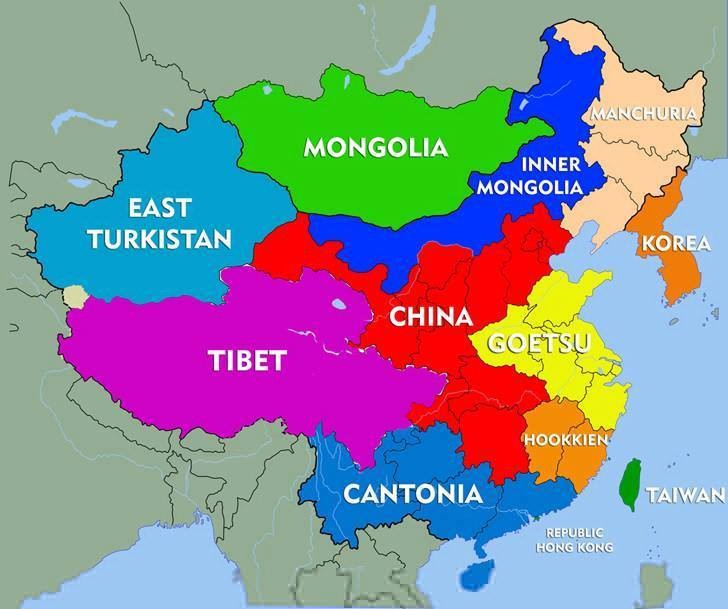
The first part of this study traced how the Qing Empire’s legacy has shaped the modern Chinese state’s approach to its Inner Asian borderlands — Manchuria, Inner Mongolia, Tibet, and Xinjiang. These cases demonstrated that the People’s Republic of China inherited not only the territorial extent of the Qing but also its governing principle: formal “autonomy” under firm central control. Across each region, Beijing’s long-term objective has been to transform former imperial peripheries into integral components of a unified national state. This process has combined economic development with demographic engineering, cultural assimilation, and the reinterpretation of imperial expansion as part of an unbroken national history.
The second part continues this analysis, focusing on the contemporary transformation of Xinjiang as the culmination of that broader trajectory. Here, the imperial logic of frontier management is updated with twenty-first-century technology and ideological tools. Through mass internment, digital surveillance, and large-scale Han migration, China seeks to “de-ethnicize” and fully integrate the region into its national framework. In Mankoff’s view, Xinjiang represents the final and most intense stage of China’s evolution from empire to nation-state — where historical narratives and modern control mechanisms converge to dissolve the distinct identities that once defined its borderlands.
Tibet today remains culturally distinct but politically integrated. The Party argues that improved living standards and infrastructure will win Tibetan loyalty, while critics point out that fundamental freedoms were lost. Mankoff describes Tibet as an example of “empire-lite” rule turned hardline: China invokes historical ties to legitimize control even as it steadily erodes Tibetan autonomy and identity.
Xinjiang: Technology, Camps, and the New Face of Assimilation
Xinjiang is China’s most complex and volatile borderland. Officially the Xinjiang Uyghur Autonomous Region (XUAR) combines two very different zones – the northern Junggar steppe and the southern Tarim Basin oasis lands. In 1955 Beijing formalized Xinjiang’s status as an autonomous region to include multiple Muslim nationalities. China’s textbooks stress that Xinjiang “has been an important part of China” since antiquity, citing Han and Tang dynasty protectorates along the Silk Road. Uyghurs, Kazakhs, Kyrgyz and other Muslim groups counter that the Tarim Basin’s identity derives from indigenous Turkic heritage and Central Asian history. They point to East Turkestan’s ancient oasis kingdoms, Islamic culture and periods of self-rule as evidence of a distinct regional identity.
Mankoff recounts that Xinjiang was integrated into China only under the Qing. In the 1750s the Qianlong emperor ordered the destruction of the Zunghar Mongol Khanate. Qing armies (aided by smallpox) nearly annihilated the Zunghars, depopulating the northern steppes. The Qing then resettled those lands with Dungan (Hui) Muslims and Turkic farmers. They also subdued the Tarim Basin cities (Yarkand, Kashgar, Khotan, etc.) by co-opting local khans and exploiting rivalries among Muslim leaders. In 1884 the Qing formally proclaimed Xinjiang a province, but central control remained weak. After the Qing fell in 1911, Xinjiang fragmented under warlords and Soviet influence. In the 1930s Moscow backed Uyghur and Kazakh rebellions and even helped create the short-lived Second East Turkestan Republic (ETR) in the Ili valley. Mankoff notes that the memory of that Soviet-backed republic – the closest thing yet to an independent East Turkestan – remains sensitive for Chinese leaders.
Since 1949, Beijing’s approach has been nominal autonomy coupled with gradual integration. The XUAR was officially multiethnic, not a Uyghur “homeland” per se. But state policies encouraged Han and Hui migration. In 1941 over 80% of Xinjiang’s 3.7 million people were Uyghur; by 2010 Uyghurs made up only 46.4%. This demographic shift resulted largely from state-sponsored projects. The Xinjiang Production and Construction Corps, for example, settled Han and Hui veterans on farmland. Infrastructure projects attracted skilled migrants, and urban development drew Chinese workers to the cities.
Xinjiang’s governance reflects a strategy of divide and rule. The region is dotted with “sub‐autonomous” prefectures and counties for minorities like Kazakhs, Kyrgyz, Tajiks and others. These subdivisions cover more than half of Xinjiang’s land. Mankoff explains that this system gave minority leaders a stake in the regime: local Kazakh and Kyrgyz elites received preferential treatment and generally cooperated with Beijing, which helped prevent a broad anti‐Chinese coalition. In practice, however, all real power is held by Han authorities. The regional Party secretary, governor and top officials are Han Chinese, and the police, military and security services are dominated by Han cadres. Uyghurs and other Muslims may serve in people’s congresses or cultural organizations, but these bodies have little independent authority.
By the 2010s, Xi Jinping concluded that economic growth alone would not secure Xinjiang. Despite billions spent on new roads, railroads and factories, violence and unrest continued. In 2014 Xi admitted that “development does not automatically bring lasting order.” The government then launched a sweeping security campaign. Massive surveillance systems (cameras, checkpoints, DNA databases) were deployed across Xinjiang, and reports surfaced of hundreds of thousands – possibly over a million – Uyghurs and other Muslims held in “political education” camps. Leaked documents indicate the goal is the wholesale secularization and “de-ethnicization” of Uyghur society. As Mankoff observes, the Party’s message is to accelerate Xinjiang’s transformation “from a postimperial borderland to an undifferentiated component” of China.
From Empire to Nation-State: China’s Final Transformation
In Mankoff’s assessment, Xinjiang’s trajectory reflects China’s broader post-imperial dilemma. Today the PRC claims the Qing empire’s full territorial inheritance (except Outer Mongolia), but it is abandoning the Qing’s segmented frontier model in favor of a unified, Han-centric state. “If Beijing succeeds in consolidating its grip on Xinjiang (and Tibet)…” Mankoff writes, “it will have moved further down the path from empire to national state”. History suggests this nation-building often comes at high human cost.
Internationally, China’s Xinjiang campaign has drawn outrage, but Mankoff stresses that other authoritarian states have used brutality to tame restive borderlands. He compares China’s methods to Turkey’s repression of Kurds and Stalin’s deportations of Caucasian minorities, noting that anxiety over separatism often provokes violent crackdowns. What makes Xinjiang different is scale and technology: pervasive CCTV and digital monitoring give Beijing unprecedented reach.
Importantly, China’s regional environment offers it a free hand. Its old imperial rival, Russia, is now a strategic partner. Central Asian governments – including Kazakhstan – rely on Chinese trade and investment and have shown little appetite to confront Beijing over Xinjiang. Without a great-power challenger on its frontier, China faces minimal risk of foreign intervention. As Mankoff observes, Beijing is largely “free” to shape Xinjiang as it wishes. Coupled with cutting-edge surveillance and a growing Han presence, this means China can press its assimilation strategy harder than any earlier empire could have dreamed.
Ultimately, Mankoff concludes, the fate of China’s borderlands will hinge on the durability of the Communist regime. As long as the Party remains strong, Beijing appears committed to subsuming Tibet, Xinjiang and other peripheral regions into a single national framework. But he warns that the distinct identities and grievances of these peoples have not been eradicated; if central control ever weakens, the legacy of empire and the aspirations of these minorities could re-emerge with significant consequences.
Sources: Analysis based on Jeffrey Mankoff, “China’s Inner Asian Borderlands,” in Empires of Eurasia: How Imperial Legacies Shape International Security, with contextual data on Kazakhstan from Lawfare. (All quotations are from the cited lines of Mankoff’s chapter.)
