


Women in Abu l-Ghazi’s Shajara-i Turk
The history of seventeenth-century Central Asia is more than a chronicle of conquests, power struggles, and dynastic ambitions. It also offers a window into the social and cultural attitudes of the time. In a patriarchal society, where accounts of heroic deeds centered on men—rulers, warriors, and dynastic founders—women often remained on the margins of historical narratives. Yet the ways in which women are portrayed in chronicles and historical accounts can reveal much about the underlying mechanisms through which power, legitimacy, and dynastic memory were established and maintained.
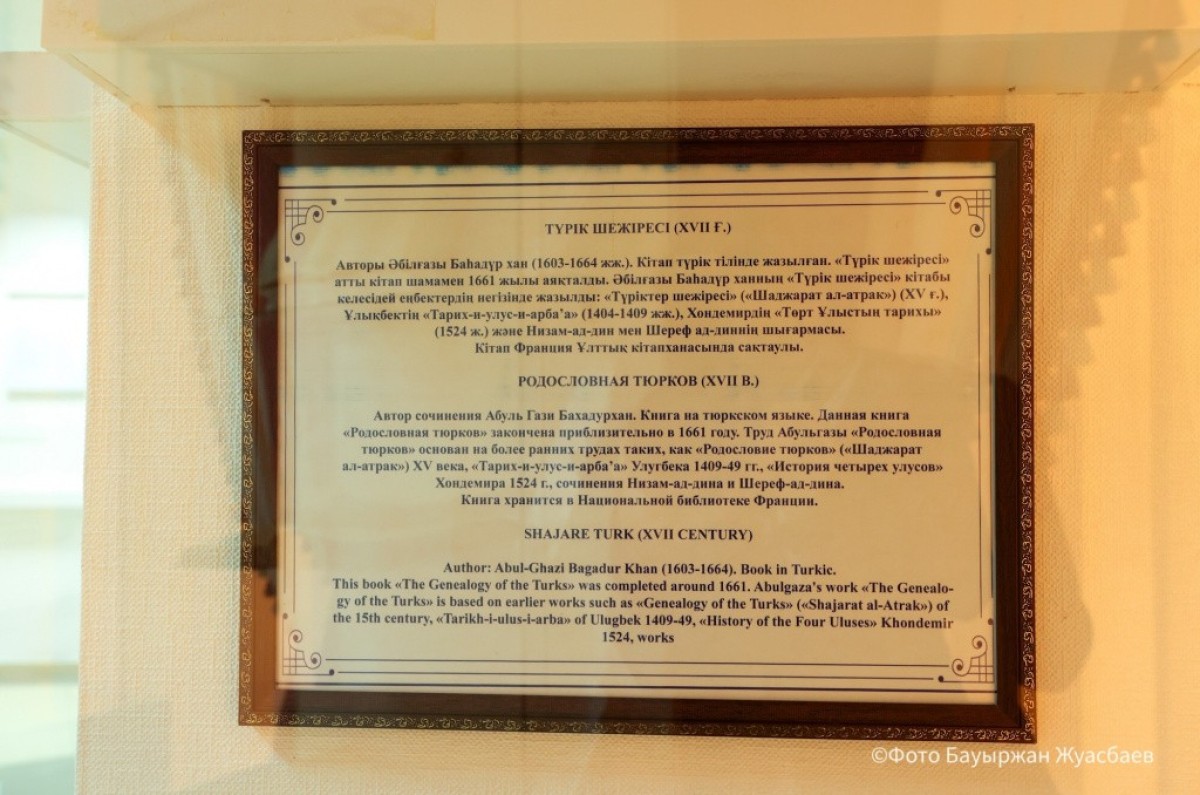
One of the key sources for understanding these attitudes is Shajara-i Turk (Genealogical Tree of the Turks), a work by the seventeenth-century Khan of Khiva and chronicler Abu l-Ghazi Bahadur Khan. Written in the tradition of genealogical chronicles, it combines legendary and historical elements to establish the legitimacy of the author’s ruling dynasty, which traced its ancestry to Genghis Khan. Although the work focuses primarily on men—their achievements, ancestry, and authority—it also features a number of women whose portrayals carry symbolic and ideological significance.
In her article “Women in Abu l-Ghazi Bahadur Khan’s Shajara-i Turk,” the scholar Barbara Kellner-Heinkele examines this largely overlooked aspect of the Khivan khan’s work. She analyzes how women are portrayed in the text, the contexts in which they appear, and the roles they play within the narrative. Kellner-Heinkele demonstrates that even brief, generalized references to women reflect not only the author’s personal attitudes but also broader perceptions of women’s place in the patriarchal political culture of the early modern period.
Kellner-Heinkele’s article thus does more than fill a gap in the study of Abu l-Ghazi’s writings. It offers a fresh perspective on the portrayal of women in the Turco-Mongol historiographical tradition, showing how women, despite their seemingly secondary role, often formed the vital links through which kinship, power, and dynastic fortunes were shaped.
Source: Barbara Kellner-Heinkele, “Women in Abu l-Ghazi Bahadur Khan’s Shajara-i Turk”
The Work and Its Portrayal of Women
The following discussion presents the findings of a search for references to women in Abu l-Ghazi’s Shajara-i Turk. The material is divided into three main categories: “good” women, “neutral” women, and “bad” women—that is, women whom Abu l-Ghazi portrays in a positive, neutral, or negative light. An attempt is then made to interpret some of the passages concerning women. Finally, the discussion considers the outlook that informed Abu l-Ghazi’s writing.
The text contains a small number of references to women who are clearly portrayed as possessing high status, a virtuous character, or a positive influence. Other episodes single out women for their negative character traits or harmful actions. By far the largest category, however, consists of women portrayed in neutral terms: those who are given no distinguishing characteristics or are mentioned only in general terms, often simply as groups of women. Overall, women remain in the background of Shajara-i Turk. They are not central to the author’s concerns, even though dynastic cohesion is one of his principal preoccupations. Rather, his account appears to be shaped by the conviction that men make history, while women constitute—or perhaps provide—the social and material capital on which men depend.
This brings us back to the fact that Abu l-Ghazi’s Shajara-i Turk is less a general history of the Mongols and Turks than an account of the dynastic relationships of the Genghisids and their various branches. Although it offers an overview of Mongol and Turkic history, its primary purpose is to advance the author’s personal agenda: to preserve for posterity the preeminence and legitimacy of his own family. He traces his lineage from Adam to Genghis Khan and then through successive generations to his immediate family and himself. Written with this objective in mind, the work incorporates both legendary accounts and historical events, but its overriding concern is to establish genealogical authenticity. The first fifth of the book, Chapters I–II, covering the period from Adam to Genghis Khan, is largely legendary. It includes the story of Oghuz Khan, told in almost the same words as in Shajara-i Tarakima and bearing close similarities to the Oghuznama account in Rashid al-Din’s Jami al-Tawarikh. Chapters III–VIII deal with Genghis Khan and his descendants, while the ninth and final chapter traces the dynastic history of the descendants of Shiban Khan, a grandson of Genghis Khan, in Khwarazm, Transoxiana, and Khorasan. Particular attention is given to Abu l-Ghazi’s own family, culminating in an account of his life. The ninth chapter thus accounts for almost half the book.
This genealogical survey of the Genghisids, spanning nearly four centuries, is written in a simple, concise style. It follows both collateral and direct lines of descent, making the narrative confusing at times. Dates are almost entirely absent. The text becomes lively and expressive only when Abu l-Ghazi turns to his memories of his immediate family, particularly events that took place during his father’s lifetime and his own adventures. This final section can, with some justification, be described as autobiographical. It should be remembered, however, that Abu l-Ghazi omits certain events of which he was less than proud. As a result, he leaves considerable gaps in the account of his activities and whereabouts during the years before he became Khan of Khiva in 1643–1644. Despite the bloodshed and armed conflicts among relatives that dominate the narrative, the work is permeated by the outlook of a devout Muslim. Although Abu l-Ghazi expresses deep regret over his harsh treatment of the Turkmen tribes in the introduction to Shajara-i Tarakima, he apparently regarded the killing of rival relatives and other opponents as unavoidable.
Women Portrayed in a Positive Light
When we read Shajara-i Turk with its structure and underlying outlook in mind, we find that the “good” women—that is, women presented as important, respected, or even revered—are primarily figures from steppe mythology or Muslim legend, along with those who held a significant place in Genghisid history. The text is arranged in a roughly chronological order. Although Hawwa (Eve) is not mentioned alongside Adam, the wife of Nuh (Noah) and his three daughters-in-law are listed among the devout believers who survived a deadly disease that struck those who had lived through the Great Flood. The mother of Oghuz Khan is subsequently portrayed in a highly positive light because she secretly embraced Islam at the insistence of her infant son, Oghuz Khan. Another “good” woman is Oghuz Khan’s third wife, who also secretly converted to Islam and helped him thwart a deadly plot against him by his idol-worshipping father, Qara Khan. The text also mentions the lawful wives of Oghuz Khan’s six illustrious sons, whereas many of his other sons are simply said to have had countless concubines. Each of the six sons had four sons by his lawful wives, but only the male descendants are named. Later in the narrative, two descendants of Oghuz Khan are said to have taken refuge with their wives in the Ergenekon Valley, where their families multiplied until they eventually left the valley because of overpopulation.
Up to this point, no woman in the text has been mentioned by name. This changes with the beginning of the next period, as the narrative moves from the mythical women of the pre-Genghisid era to women associated with the early history of Genghis Khan. A longer passage is devoted to the famous Alan Goa, the legendary ancestress of Genghis Khan (r. 1206–1227), who, according to Abu l-Ghazi, was the granddaughter of a certain Yulduz Khan from the post-Ergenekon period. (Abu l-Ghazi is clearly not referring to the third son of Oghuz Khan.) In a later passage, Abu l-Ghazi traces his father’s complete genealogy back to Alan Goa. In other words, the transition from legendary to historical narrative in Shajara-i Turk occurs as the author sets the stage for the emergence of the Genghisids by listing the various tribes and peoples who inhabited the steppe at the time of Genghis Khan’s rise. Abu l-Ghazi presents a somewhat confused picture, tracing the ancestry of the Turks and Mongols back to Adam and then, with little explanation, linking their historical fortunes to the Genghisid dynastic network, which is connected in one way or another to his own lineage. Questions of who was a Turk and who was a Mongol seem to be of lesser importance to him. His attention is focused on the Turkic-speaking Islamic world of Khwarazm and Transoxiana. What matters above all is the legitimacy of political power.
After the legendary Alan Goa, the next woman introduced by the author (apart from Terken Khatun) is Genghis Khan’s mother, Hoelun. She is well known from The Secret History of the Mongols, which describes in detail her difficult life as an impoverished widow raising unruly children and her courageous conduct in the face of her family’s enemies. Some attention is also given to Börte, Genghis Khan’s first and principal wife. Abu l-Ghazi firmly identifies Genghis Khan himself as the father of Jochi (d. 1227), whom Börte carried in her womb. After Börte, the author names four other women, giving their family backgrounds and identifying them as the highest-ranking among Genghis Khan’s 500 wives and concubines. His list, however, differs from Rashid al-Din’s account of Genghis Khan’s principal wives. He names “Kunju,” daughter of Altan Khan, as the khan’s second wife; “Kuisu,” widow of Tayang Khan of the Naimans, as his third; and the Tatar sisters “Missulun” (Yesui) and “Issuken” (Yesugen). Abu l-Ghazi also mentions that “Bukay” (Bükey), the beautiful daughter of the chief of the “Nekrin or Mekrin” tribe, was given to Genghis Khan as a token of peace.
Some of Genghis Khan’s sons also had prominent wives who are mentioned by name. According to Abu l-Ghazi, Ögedei (r. 1229–1241) had four lawful wives and 60 concubines. His second wife, “Turakin” (Töregene), a woman of the Merkit tribe described as ugly, was nevertheless considered beautiful by Ögedei himself. The eldest of her five sons by Ögedei, Güyük (r. 1246–1248), had three sons by his wife “Kamish,” who became regent of the empire after Güyük’s death (1248–1251). Ögedei’s younger brother Tolui (d. 1232) had a son, Möngke (r. 1251–1259), by his wife “Surkukti-Bigu” of the Tatars (Sorghaghtani Beki), who, according to Shajara-i Turk, was greatly loved by the people. Of Chagatai’s (d. 1242) numerous wives and concubines, only two sisters from the noble Qiyat-Qongirat lineage are named: “Issulun” (Yesülün) and “Turkan Khatun” (Tögen). It is worth noting that the Qongirat clan already played an important role in the politics of Khwarazm and Khiva during Abu l-Ghazi’s lifetime. Some 140 years after his death, however, the Qongirats removed the Genghisids from the throne of Khiva and established their own dynasty, which ruled with a measure of success until the Russian conquest of 1873.
After discussing the descendants of Chagatai, Abu l-Ghazi’s systematic dynastic account of Genghis Khan’s descendants turns to the house of Shiban, Jochi’s fifth son, from whom Abu l-Ghazi himself was ultimately descended. One detail in his account deserves particular attention: Timur Shaykh Khan, an eighth-generation descendant of Shiban Khan, died without leaving any sons. One of his wives, however, was pregnant with Yadigar, who became khan of most of the Uzbeks in 1457–1458. Abu l-Ghazi regarded Yadigar as the direct ancestor of the Arabshahid Khivan khans—that is, his own dynasty, which ruled from 1511 until the end of the seventeenth century.
Abu l-Ghazi also accords his mother, Mihribanu Khanum, an honored place in his genealogy. Like his father, Arab Muhammad Khan (r. 1602/03–1621), she was descended from Yadigar Khan, the ancestor of the Khwarazmian Genghisids. Arab Muhammad Khan also told his son that Mihribanu Khanum belonged to a branch of the Yadigarid lineage known as Ghazi, which was one of the reasons the author was given the name Abu l-Ghazi. Mihribanu Khanum died when her only son, Abu l-Ghazi, was just six years old. Abu l-Ghazi himself married at the age of 16 and was sent to Urgench, where he was to share power with his elder half-brother Habash. Abu l-Ghazi says nothing about his first wife’s family. Nor does he mention any of his wives or children, not even his son Anusha Khan, who succeeded him. Nevertheless, given that the khan spent many years living in neighboring lands, including Samarkand and Iran, as well as among the Kazakhs, Turkmens, and Kalmyks, it is possible that Abu l-Ghazi maintained several households.
An analysis of the women portrayed positively in Abu l-Ghazi’s Shajara-i Turk suggests that a woman’s personal prestige increased with her proximity to Genghis Khan. Similarly, the higher a woman’s status, the more likely the author was to mention her by name. Some women are also portrayed favorably because of their beauty or intelligence, or because they belonged to influential families that supported the Genghisids. Earlier sources on Mongol and Turkic history, such as Rashid al-Din’s Jami al-Tawarikh, illustrate this pattern in greater detail and probably served as models for later historians. Abu l-Ghazi undoubtedly drew on Jami al-Tawarikh, either directly or indirectly. However, since his account differs from Rashid al-Din’s work in many respects, he must also have relied on other written or oral traditions, in addition to his own recollections.
Women Portrayed in Neutral Terms
Most of the women presented in ethically neutral terms in Abu l-Ghazi’s Shajara-i Turk can be placed in a category that might be described as “useful in one way or another.” This is consistent with the restrained manner in which Islamic and other preindustrial sources generally described women. The two main subcategories within this group of “useful” women are, on the one hand, “women as guarantees of peace” and, on the other, “women as hostages of war.” All the examples come from the sections dealing with the Genghisids and the subsequent chapters. One example of a woman serving as a guarantee of peace, or as a pledge of peaceful intentions, appears in the account of Arslan Khan of the Qarluqs, who offers his unnamed daughter to Genghis Khan. Genghis Khan reciprocates by giving him a princess from his own family in marriage. Similar arrangements between Genghis Khan and the Oirats and Uyghurs are also recorded. The practice of exchanging women from ruling families as guarantees of newly concluded peace treaties and pledges of loyalty had been known in the steppe since time immemorial. It was also common in relations between the steppe peoples and sedentary states, as exemplified by the diplomatic marriages between the Turks and Uyghurs on the one hand and the Chinese on the other. Other examples in the text concern politically advantageous (“useful”) marriages that served to legitimize a ruler’s authority. One such case involves the Chobanid Hasan-i Kuchak (d. 1343), who places Sati Beg Khatun, daughter of the Ilkhanid ruler Öljeitü (r. 1304–1316) and sister of the last Ilkhan, Abu Sa'id (r. 1316–1335), on the throne of Iran. The following year, Hasan replaces Sati Beg Khatun with Sulayman, a great-grandson of Hülegü (r. 1256–1265), and marries Sati Beg Khatun to him.
Another of Abu l-Ghazi’s accounts of women serving as links between different rulers concerns the last powerful Timurid sovereign, Abu Sa'id Mirza, one of Emir Timur’s great-grandsons (r. in Transoxiana, 1452–1467), who killed his relative Abd al-Latif Mirza (r. 1449–1450). Fearing Abu Sa'id, Abd al-Latif’s son, Muhammad-Juki Mirza, fled to the Jochid Abu'l-Khayr Khan (r. 1428–1468), whose wife was Abd al-Latif’s sister and therefore Muhammad-Juki’s paternal aunt. Muhammad-Juki’s arrival marked the beginning of strained relations between these branches of the Jochid and Timurid dynasties.
Far more numerous are the instances in which women appear as “hostages of war,” particularly women of ruling dynasties who found themselves in this position. Such episodes are relatively common. In several passages, Abu l-Ghazi describes how a victorious khan captures the wives and children of a defeated ruler and immediately incorporates them into his own harem. This practice is frequently mentioned in other sources as well, including the Baburnama and Mirza Haydar Dughlat’s Tarikh-i Rashidi. In one instance, the Mongols capture the mother, wives, and children of the Khwarazmshah Ala al-Din Muhammad (r. 1200–1220) when they storm his fortress of “Karandar.” Abu l-Ghazi concludes the account by stating that the Khwarazmshah died immediately upon hearing of his defeat.
Another example concerns Muhammad Shaybani Khan (b. 1451; r. 1501–1510), a grandson of Abu'l-Khayr Khan (d. 1468) and founder of the Shaybanid dynasty in Transoxiana. Some time after Shaybani killed his relative Berke (Bürge) Sultan, son of Yadigar Khan, Bürge’s wife, Malay Khanzade, entered the harem of Khoja Muhammad Sultan, Shaybani Khan’s paternal uncle. Bürge himself had previously killed this woman’s father! At the time, she was pregnant with Bürge’s child, but according to Abu l-Ghazi, she concealed her pregnancy. Her son was the future Janibek, grandfather of the famous Abdullah Khan of Bukhara (r. 1556/1582–1598). Here Abu l-Ghazi alludes to the interwoven relationships between two rival branches of the Jochid dynasty: his own Yadigarid line and the Abu'l-Khayrid branch of Transoxiana, which had caused his ancestors considerable trouble.
Another episode concerns the wives of Ghazi Sultan, who were abducted by the retainers of his relative and rival, Aqatay Khan. Ghazi Sultan was Abu l-Ghazi’s maternal great-grandfather, and the incident took place during a conflict between two branches of the family, marked by plundering and chaos.
Much more common are brief references to “girls and young men” from towns and rural communities who, following the capture of a city, were enslaved or taken hostage as part of the spoils of war. Such accounts appear in descriptions of the conquests of Genghis Khan and the Genghisids, and later of the Shaybanids in Transoxiana and Khwarazm. As the narrative approaches Abu l-Ghazi’s own lifetime, examples increasingly concern frequent raids on Turkmen encampments and, even more often, internal feuds among the Uzbek nobility and within Abu l-Ghazi’s own family. The same applies to conflicts between Khivan and Bukharan rivals, as well as Cossack raids during the reign of Abu l-Ghazi’s father, Arab Muhammad Khan.
Abu l-Ghazi himself was hardly scrupulous in such matters. Two instances in which he plundered Turkmen encampments and enslaved women and children are mentioned in the section of the work written by his son, Anusha Khan, after his father’s death. However, as Abu l-Ghazi himself acknowledges in Shajara-i Tarakima, there were many more such clashes with the Turkmens. In one passage, he recounts how he managed to force the Uzbek clans into submission by threatening them with the prospect of Kalmyks arriving to enslave their wives and children.
An interesting case of a “victim of war” concerns Abu l-Ghazi’s paternal great-grandmother. Since one of the Khivan khans’ longstanding political objectives was to maintain control over the Turkmen tribes, raids on their encampments were frequent, particularly when they failed to pay the required tribute. During one such campaign, Abu l-Ghazi’s great-grandfather, Aqatay Khan (r. 1549–1556), captured a young woman from the Göklen tribe and took her into his harem. She became the mother of Abu l-Ghazi’s grandfather, Hajim Khan (Haji Muhammad), meaning that Abu l-Ghazi himself was also of Turkmen descent.
A similar episode concerns a woman who was used as bait in a trap set for a certain Muhammad Ghazi Sultan, a member of the maternal branch of Abu l-Ghazi’s family, during a family feud. The sultan’s young and beautiful sister was married to the elderly Avanesh Khan (r. 1525/26–1539/40), a grandson of Yadigar Khan. The reckless Din Muhammad Sultan, Avanesh Khan’s eldest son, harbored a grudge against Muhammad Ghazi Sultan and sent him a letter in his sister’s name, pretending that she missed her brother. It was a trap designed to enable Din Muhammad to kill his relative when he came to visit his sister in the women’s quarters. The murder set off a bloody succession of killings within the family.
Women Portrayed in a Negative Light
Finally, we turn to the negative qualities that Abu l-Ghazi attributes to certain women, almost as though he wished to warn his readers that women were inherently deceitful and malicious. The first woman to appear in this category in Shajara-i Turk is a certain Terken/Tergen Khatun, the powerful wife of the Khwarazmshah Tekish (r. 1172–1200) and influential mother of the Khwarazmshah Ala al-Din Muhammad (r. 1200–1220). A princess of the Turkic Qangli (or Qipchaq) tribe, she is credited by the author with helping to spread Islam among her fellow Qangli, who followed her into the service of the Khwarazmshah. Abu l-Ghazi reports that Ala al-Din Muhammad suspected his mother, Terken Khatun, who frequently pursued an independent political course, of conspiring against him and executed her alleged accomplice. According to the author, this was one of the factors that contributed to the downfall of the Khwarazmshah and his state.
Another example, which Abu l-Ghazi recounts in considerable detail, is the historically attested story of the wife of the Chobanid Hasan-i Kuchak (Hasan the Little), who had an affair with one of his relatives. When Hasan imprisoned the man, the woman assumed that her husband had discovered their relationship. One night, she killed Hasan by crushing his genitals.
Women, however, are portrayed as treacherous not only toward men but also, quite frequently, toward one another. Abu l-Ghazi claims that a childless first wife kicked her husband’s pregnant concubine in an attempt to cause a miscarriage, but failed. After giving birth, the unfortunate concubine hid her child in the bushes. The infant was rescued and went on to become the eponymous founder of the Sukut clan (el), a branch of the Baryn closely associated with the Dörben el. The khan relates this story in the course of his survey of the Turkic and Mongol tribes that later formed the population of Genghis Khan’s empire. It is not entirely clear why Abu l-Ghazi considered the story worth including, but it illustrates that the son of a concubine could be regarded as worthy of leading a clan of his own.
In another case, the senior wife of Avanesh Khan, brother of Abu l-Ghazi’s great-grandfather Aqatay Khan, treats Din Muhammad Sultan with appalling cruelty. Din Muhammad was the young son of a junior wife who was herself “merely” the daughter of a Manghit mirza’s concubine. Abu l-Ghazi reports that the junior wife herself said she had been captured when her tribe was dispersed and subsequently sold to the khan. Whether Din Muhammad Sultan’s later behavior was the result of his traumatic childhood or his innate character remains unknown, but as an adult he committed acts of murder and oppression relentlessly. Although Din Muhammad was a cousin of Abu l-Ghazi’s grandfather, Hajim Khan, this account has no genealogical implications for Abu l-Ghazi’s family, yet the author devotes considerable space to it. From the earlier episode involving Din Muhammad, however, we know that he killed members of the maternal branch of Abu l-Ghazi’s family. The account also confirms that the Mongol tradition of entrusting the upbringing of junior wives’ children to senior wives was still practiced among the Yadigarids in the late sixteenth century.
Another story of a deceitful woman, which Abu l-Ghazi relates with evident relish, concerns a dancer (Persian: luli) in Merv who had a young son but apparently no husband. One day, she stood up before the beks and declared that the boy was a “souvenir” of a night spent with Abu'l-Muhammad Khan, the Yadigarid ruler of Merv and son of the ill-natured Din Muhammad mentioned above. She claimed that she had kept the encounter secret for fear of the khan’s principal wife (khanum). The khan, who was ill and still mourning the death of his only son, eventually acknowledged the boy as his illegitimate child and named him Nur Muhammad (“Light of Muhammad”). Several aspects of this episode deserve attention: the dancer’s audacity, the opportunism of the beks, and the desperation of the khan, who preferred to acknowledge a questionable liaison rather than abandon the faint hope of leaving his khanate to an heir. Nur Muhammad, a contemporary of Abu l-Ghazi’s grandfather Hajim Khan and a participant in his territorial wars against Abdullah Khan of Bukhara, left no descendants and died in exile in Iran. Since the story of the luli has no other apparent consequences in Abu l-Ghazi’s narrative and is absent from Firdaus al-Iqbal, it may be assumed that he included it simply because he regarded it as an amusing family anecdote that vividly illustrated the tricks women could employ.
If we take the interpretation a step further, however, we might also suggest that Abu l-Ghazi wished to emphasize that false claims to dynastic recognition inevitably end in disaster. The suggestion that Nur Muhammad met a miserable end in Iranian exile may carry another implicit message: an impostor is likely to be weak in faith and may seek refuge among the Shiite Persians if his own people cease to support him. Yet there is a touch of irony here. A number of Yadigarids, including Abu l-Ghazi’s father, Arab Muhammad Khan, sought refuge with the shah when defeat drove them out of Khwarazm. Abu l-Ghazi himself spent more than ten years in exile at the Safavid court in Tabriz, although he describes this period of his life only briefly. Indeed, the autobiographical section of Shajara-i Turk tells us little more than that he lived in Tabriz and managed, through a series of stratagems, to escape and return to his native Khwarazm. Or should we see the story of the luli as further evidence of Abu l-Ghazi’s unwavering determination to uphold Genghisid legitimacy? He himself had endured the ordeal of exile in Iran—did this mean that fate had destined him for success and eventual accession to the throne?
* * *
In Shajara-i Turk, Abu l-Ghazi mentions a woman or women on nearly a hundred occasions. In most cases, they remain unnamed, as the author apparently considered it sufficient to identify them as “so-and-so’s wife, concubine, mother, sister, or daughter,” or simply as a woman from a particular tribe. With a few exceptions, such as when he relates a short story about a woman, the khan’s remarks about women are brief and incidental. This stands in sharp contrast to the vivid and sometimes strikingly personal descriptions of women found in the autobiographical Baburnama, which provides a useful point of comparison. Some of Babur’s passages are quite lengthy and can be regarded as miniature biographies, particularly when he describes strong-willed female relatives, such as his grandmother. He respected and even admired these women for their intelligence and energy, while criticizing others with considerable eloquence. Like Abu l-Ghazi, Babur—probably out of respect for tradition and in keeping with conventional attitudes—assigns women the social roles of mothers and virtuous, obedient wives. Daughters and sisters from noble families were expected to play their part when men formed alliances and sought to consolidate power and loyalty, even if this required sacrificing their own interests for those of the family or becoming “hostages of war.” For both authors, women fulfill the roles prescribed by the social conventions of their time and region.
Nevertheless, there is a structural difference between the two works. In the Baburnama, female figures appear within the biographical portraits that Babur writes of the men in his extensive family who lived during or close to his own lifetime. Mothers, wives, concubines, sisters, and daughters are systematically mentioned in the accounts of individual men, reflecting Babur’s close personal familiarity with them. Abu l-Ghazi’s references to women are more impressionistic, appear in a wider variety of contexts, and span several centuries. Other differences between the two works concern their literary quality and the authors’ motivations. Babur’s aim was to record the events, dreams, and emotions of his life and to express his understanding of his era and the world around him. His writing is elegant yet straightforward. Abu l-Ghazi’s ambitions were considerably more modest: he sought to compile a genealogical account of his dynasty covering a much longer historical period. Although Abu l-Ghazi was far better educated than his Khivan contemporaries, particularly in history, and knew several languages, his works Shajara-i Turk and Shajara-i Tarakima are simple in style and limited in scope. Their value lies in the scarcity of surviving historical sources from that period and region, as well as in the unique information they contain that is unavailable elsewhere. Aware of the widespread lack of historical knowledge among both the Uzbeks and the Turkmens, Abu l-Ghazi sought to preserve the past as he knew it, including both mythical history and the history of the Islamic world of Persia and Central Asia, from the era of the Khwarazmshahs to the Mongol conquests. The names of prominent women formed part of this historical knowledge. Above all, however, the author was concerned with matters relating to his own family, of which he was evidently proud. Moving chronologically through a complex web of kinship ties—generation by generation, branch by branch—the text pursues a single objective: to demonstrate an unbroken dynastic line from Adam, through Genghis Khan, to the author himself. Given that Abu l-Ghazi was constantly engaged in struggles against members of other branches of his family and the Uzbek nobility of Khwarazm, Transoxiana, and Khorasan over power and territories he regarded as his rightful inheritance, it becomes clear just how important legitimacy was to him. He understood it as resting on bloodline, military prowess, and success in government. Against this background of Genghisid legitimacy, we can better understand why the nineteenth-century Khivan historians Munis and Agahi sought to emphasize the legitimacy of the non-Genghisid Uzbek Qongirat khans, who had displaced the Genghisid Arabshahids from the throne of Khiva by the end of the eighteenth century (formally in 1804).
These court chroniclers justified the new Qongirat dynasty by arguing that its khans had demonstrated the traditional virtues of male leadership and become reliable defenders of Islam, whereas the Genghisids had forfeited their right to rule by proving themselves deficient in their Muslim faith and unreliable as rulers. Indeed, Abu l-Ghazi’s works do not always conform to Islamic moral standards, although the roles he assigns to women could be said to fit within traditional Islamic conceptions. He apparently mentions prominent women from mythical times and the Genghisid era in order to preserve their rightful place in collective memory. As the narrative approaches his own period, however, covering the sixteenth and seventeenth centuries, Shajara-i Turk increasingly confines its treatment of women to recording dynastic births and marriages, the sacrifices women made in men’s power struggles, and occasional entertaining or even humorous anecdotes featuring morally ambiguous female characters, such as the story of the luli mother.
To conclude, it is worth recounting one of Abu l-Ghazi’s own stories, which adds an amusing yet revealing touch to his otherwise austere dynastic narrative. The anecdote concerns two of his relatives: Aziz Khanum, his maternal great-aunt by a collateral line, and Pulad Sultan, his paternal great-uncle, a son of his great-grandfather Aqatay Khan. The author describes Pulad Sultan as a cowardly and foolish man about whom he had heard many stories during his childhood. On one occasion, while in the women’s quarters, Pulad Sultan could not stop boasting about his “heroic deeds” in a battle against a Bukharan enemy, even though he had actually fled the battlefield that very day. His principal wife, Aziz Khanum, a daughter of Ilbars Khan and, like her husband, a Genghisid, was ashamed of his behavior in front of the other women and tried to silence him. Pulad Sultan, however, began insulting her. Khanum responded with a sharp-witted retort, then seized a stick and chased after him. He ran across the room, tripped over a sofa, and broke his leg. We may conclude that Abu l-Ghazi Bahadur Khan understood very well the role women could play in bringing unworthy men down.
