


Kazakh-American Collaborative Research. Findings of the 1990 Field Season
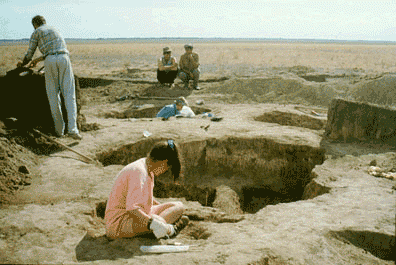
After a survey of the Semirechiye region in Kazakhstan, in 1990 there was established the Kazakh-American Research Project Inc. – a non-profit California organization located in Berkeley – the main goal of which was to conduct an exchange program with the Institute of History, Archaeology and Ethnography, Academy of Sciences, KazSSR in Alma Ata. The purpose of organization’s first season, 22 April through 2 June 1990, which included ten Americans and Canadians, was to join Kazakh archaeologists at two archaeological sites, to evaluate other excavation sites, and to investigate ethnographical subjects for future studies. “Qazaqstan Tarihy” will report on what the joint Kazakh-American Research Project Inc. spent a whole month doing in the Almaty region in 1990.
At that time, Indo-European Saka («саки») tribes were the earliest nomads known in Central Asia. Between the eighth and third centuries BC, the Saka engaged in animal husbandry, migrating as the supply of grazing lands dictated. When these Early Iron Age nomads began to attack and loot their sedentary neighbors, contact between the Saka and the West began to be recorded.
Organization’s first excavation was kurgan 11, a Saka burial mound, in the Issyk II cemetery located near the town of Issyk, about fifty kilometers northeast of Alma-Ata, the former capital of Kazakhstan. Although this kurgan had been robbed of its precious metals during the seventeenth-century Russian expansionist period, the remaining articles allowed expedition to date the kurgan to the fifth to third century BC.
The relatively small kurgan, belonging to a lesser Saka chieftain, measured about 15 m in diameter and stood about 1 m above the surface of the present ground level. Within the crypt, located about 1.3 m below ground level, archeologists found two unusual ceramic vessels, each decorated around the shoulder with a punctate triangle design. Three nicely polished bone arrowheads, the remains of three iron arrowheads, and an iron knife in a leather sheath were grave offerings remaining in the kurgan. Skeletal remains revealed that the chieftain died at a relatively early age, probably of an infectious disease. Other finds of interest from the Issyk II cemetery were a pair of anthro-zoomorphic silver plaques cast in the form of heraldic bull-headed men with feline bodies, feet, and tails. Stylization of these plaques indicates that the Saka buried at the Issyk II cemetery also had connections with the ancient Near East.
In the late sixth century AD, Central Asia was briefly unified under the Turks. Political and economic ties were established with China, Persia, and Byzantium. It has often been observed that the exchange of goods may have been secondary to the exchange of cultures. In Southern Kazakhstan, mounds define fortified citadels and caravanserais that once supported the ancient Silk Route of Marco Polo fame. Kos Tobe, one of these gorodishches (archaeological sites), and the site of our second excavation, is located about twenty kilometers from Djambul in the Djambul region (modern city of Taraz and the Zhambyl Region, respectively). This citadel was occupied from the seventh century AD, and ultimately met its demise at the hands of the Chingiz Khan hordes in the fourteenth century. Kos Tobe had been protected by a wide moat between the double walls. Adjacent to the citadel we excavated in cemeteries 1 and 2. The lower strata of both cemeteries, dating from the seventh to ninth centuries AD, show evidences of several different cult and religious practices. Reburials, including a cultic dog burial, were common during the early period. Offerings placed in one tomb containing eight skeletons indicate that, in addition to Zoroastrians, Buddhists and Christians lived side by side in Kos Tobe.
The spread of Islam throughout the nomadic Kazakh steppes was much slower and more superficial than in Central Asia, while sedentary cultures living in southern Kazakhstan were relatively well islamicized. In Turkestan (Shymkent Region), Tamerlan ordered a mausoleum built in the Timurid style for Akhmed Yasavi, an important Sufi mystic who taught in the thirteenth century.
In the region surrounding Turkestan, and at the mausoleum, evidence of the so-called "Muslim Revival" in the Soviet Union is apparent. Pilgrim ages are made to several holy places. At the mausoleum Muslims place offerings in increments of the magic number seven in the immense bronze kotel (cauldron) which dominates the center of the main hall. This beautifully cast kettle, only recently returned at the request of local inhabitants, had been kept at the Hermitage since shortly after the Soviet Revolution.
Over time, many ethnic peoples have been relocated so that at the moment of spring 1990’s more than one hundred ethnic groups lived in Kazakhstan. Among the societal constituents to be included in future studies are the Dungans of Arabic and Chinese stock (originally from Chinese Turkestan — Tarim Basin, China), Turks, and Kurds, as well as Kazakhs living in villages. Many of this latter group continue to practice ancient sheep-breeding traditions, living in felt covered yurts while grazing flocks — were no longer owned by families but rather by collective farms.
Expedition made two treks to survey petroglyph sites, one to Tamgaly Tas (Almaty Region) and the other to Maimak (Zhambyl Region). The carvings, dating from the Neolithic through the Middle Ages, revealed ancient and traditional religio-magical world beliefs. Horned goats, camels, and horses, or a duel between warriors portrayed everyday life. In contrast, solar symbols, shamans performing rituals with immense long-horned bulls, and representations of other magical imagery depicted mythological beliefs.
In a small gorge at Tamgaly Tas, the most sacred of the mythological representations were carved. At the time area was still witness to cultic practices, for archaeologists found the bound legs of a young lamb sacrificed at the end of Ramadan. A similar rite is depicted on Scytho-Saka plaques dating to the Saka period.
As part of the exchange program, five Kazakh scholars from the Academy of Sciences in Alma Ata visited California in December 1990. Two historians gave lectures on the current political and social situation in Kazakhstan, and an archaeologist presented a slide lecture on first millennium AD sites excavated in various areas of the republic.
As the member of the expedition Jeannine Davis-Kimball noted in her Field Work Report, 1991 season will include continuing Saka kurgan excavations near Issyk as well as an immense cultic Usun kurgan (2nd–1st century BC). Members of our group will also join in the excavations at the medieval Talgar citadel (Almaty Region). Here round stone foundations within the city will be excavated in an attempt to elucidate the symbiotic relationship between nomads and sedentary populations. Also included is a survey of a cultic site, located at the 9000-foot level in the Tien Shan mountains, dating from about the fifth century BC to the fifth century AD. As she planned, expedition will also conduct cranial studies from previous excavations in the Semirechiye to determine ethnicity.
Source: Report by Jeannine Davis-Kimball, Ph.D., Director, University of California, Berkeley, Middle East Studies Association Bulletin, July 1991, Vol. 25, No. 1 (July 1991), pp. 33-35.
