



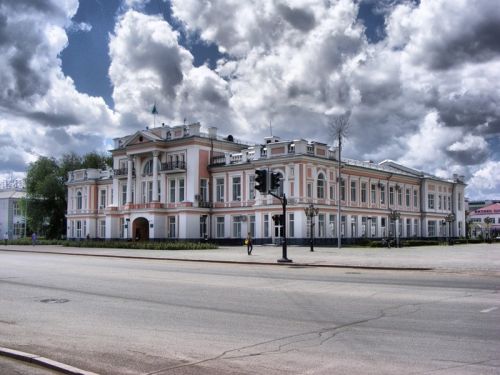
It is an admi-nistrative centre of the West-Kazakhstan Oblast. The town is situated within the Pre-Caspian cavity on the right hand bank of the river
Zhaik-Ural. From three sides it is surrounded by the waters of the rivers Zhaik and Chagan. The total territory of the town covers 700 sq. km nearly.
The town was renamed more than once. The Kazakhs call it "Teke", "Oral" and the Russians -"Yaitsky Town”, "Uralsk". The rulers of different times and regimes ordered in their own way: in 1775 by imperial decree to "Yaitsky town " was given a new name “Uralsk”for the sake of oblivion of the Pugachyov rebellion. In the age of antiquity the ancient nomadic tribes - Issedons and Sarmats settled there. In the early Middle Ages the shortest trade routes from the East to the West passed through the territory of the town.
Nomads and people who lived in the area of the actual town left after themselves various tangible monuments in the form of site of ancient settlements, stone images, wheel traces, roads, earth mound remains, earthenware crockery.
The latest archeological finds within the territory of the town suggest the existence of the town founded in the XIII century during the Golden Horde flowering. Most inhabitants of the medieval town were the Nogays-alshyns - the nearest ancestry of the Kazakhs of the Junior Zhuz..
From historical sources it is known that in 1598 at the request of the Head of the Nogays-Alshyns Ormambet the Russians built a town-fortress against the raids of Bukharians. Later this town was razed to the ground at the request of the selfsame Ormambet. The legends from life of Nogay-Alshyn population are connected with various places in the town. Among them are Khanskaya grove and Baskachkina rostosh ('Baskak' is the governor of Nogay Khan, assessment collector).
For a long time Khanskayay grove served as thearea of summer wanderings of Kipchak kxans and their summer residence. This place was held sacred since a Moslem saint was buried there. Representatives of people of the Turkic origin used to gather there on the occasion of important events and settled significant questions concerning life, peace and brotherhood. Corotiation of Kazakh khans took place in the grove. Right here in 1812 Sultan Bokey was heaved on the white felting and enunciated the Khan of the Internal Horde. In 1824 in honour of his successor Zhangir celebrations on the occasion of his enthronement took place in Khanskaya grove.
About 1613 Yaik Cossacks moved from Kirsanovsky Yar to the present area at the confluence of the Chagan and Ural The ancient part of the town raised by them is called 'Kureni'. This is a loan word from the Turkic language which means 'Kurie", 'Kora' - camp, fence, camping-ground.
Adjoining "Kureni" was a Tatar outskirts of town (the word "Tatar" is a collective name of Mongolian-Turkic tribes), an ancient wooden mosque was built there. In 1821 the famous associate of Khan Zhangir the merchant Karaul kozha Babazhanov built up a mosque at his own means in the town. After a number of years the town was growing and expanding. At the beginning of the 19th century Oral-Uralsk changed for the better: broad, straight streets took place of narrow and cramped ones.
Since the second half of the 19th century Uralsk was no more exclusively 'a capital' of the Uralsk Cossacks forces, it became an administrative, commercial and industrial, cultural and educational centre of the region. Museums, libraries and theatres have been opened there. Newspapers and magazines were published. In 1920 after declaration of the Kazakh ASSR Oral-Uralsk became an administrative centre of the Western part of Kazakhstan.
Information was taken from the site visitkazakhstan.kz
